


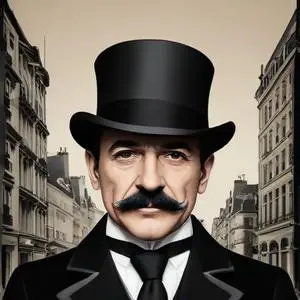
Renowned for transforming Paris into a modern city with grand boulevards, public parks, and efficient infrastructure, this urban visionary reshaped the City of Light's landscape.
Georges-Eugène Haussmann is renowned for his ambitious urban renewal program that transformed the City of Light, Paris, into the majestic metropolis we know today. As the prefect of Seine from 1853 to 1870, Haussmann oversaw the creation of wide boulevards, parks, and public works that still dominate central Paris, earning him the nickname "The Demolisher" and "The Modernizer of Paris."
Born on March 27, 1809, in the Beaujon neighborhood of Paris, Haussmann came from a family with strong administrative roots. His paternal grandfather was a deputy of the Legislative Assembly and National Convention, while his maternal grandfather was a general and a deputy of the National Convention.
Haussmann received his education at the Collège Henri-IV and the Lycée Condorcet in Paris, where he developed a passion for music, studying at the Paris Conservatory. He later joined his father as an insurgent in the July Revolution of 1830, which led to the abdication of King Charles X.
Haussmann's career in public administration began on May 21, 1831, when he was named the secretary-general of the prefecture of the Department of Vienne. He eventually became the prefect of the Department of Gironde in 1848 and later served as the prefect of the Department of Yonne in 1851.
In 1853, Haussmann's exceptional administrative skills caught the attention of Emperor Napoleon III, who appointed him as the prefect of Seine. This marked the beginning of Haussmann's most notable period, during which he would transform Paris into a modern, efficient, and aesthetically pleasing city.
Haussmann's vision for Paris was to create a city that was both beautiful and functional. He believed that wide, straight boulevards would improve traffic flow, provide better lighting, and enhance the overall quality of life for Parisians.
Some of Haussmann's most notable achievements include:
Haussmann's radical changes to Paris were not without controversy. Critics accused him of extravagance, and his projects were often plagued by corruption and mismanagement.
In 1870, Haussmann was forced to resign as prefect of Seine due to mounting criticism and financial concerns. Despite his tumultuous departure, Haussmann's legacy as the "Modernizer of Paris" remains unparalleled.
Haussmann married Octavie de Laharpe in 1838, and they had two daughters, Henriette and Valentine. He was known for his strong family ties and was deeply devoted to his wife and children.
Today, Haussmann's name is synonymous with urban renewal and city planning. His innovative ideas and vision for Paris continue to inspire architects, urban planners, and city officials around the world.
Despite the controversy surrounding his methods, Haussmann's contributions to the City of Light are undeniably remarkable. As the visionary behind Paris' transformation, Haussmann's legacy will forever be etched in the hearts of Parisians and visitors alike.
Born in 1811
The son of Napoleon Bonaparte, he was the titular Emperor of the French from 1811 to 1832, although he never actually ruled. He's known for his brief, tumultuous life and mysterious death.
Born in 1864
A post-Impressionist master of capturing Parisian nightlife, known for vibrant, expressive paintings and posters of cabarets, brothels, and high society. His works exude a sense of decadence and joie de vivre.
Born in 1830
A Danish-French Impressionist painter who captured the beauty of landscapes and cityscapes with vivid colors and bold brushstrokes, influencing the development of modern art.
Born in 1848
A French painter and engineer who captured the modernity of Parisian life in his Impressionist works, particularly in his depiction of everyday urban scenes. He's also known for his support of fellow artists, including Monet and Renoir.
