


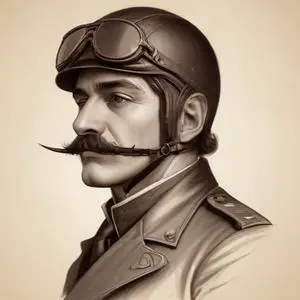
A French World War I flying ace credited with 53 victories, known for his exceptional bravery and innovative tactics in aerial combat.
Georges Guynemer, the second-highest scoring French fighter ace, is renowned for his exceptional bravery and unmatched flying skills during World War I, with an impressive 54 victories to his name. His heroic exploits in the skies made him a French national hero, and his untimely disappearance on September 11, 1917, sent shockwaves throughout the nation.
Born on December 24, 1894, in Paris, Georges Marie Ludovic Jules Guynemer was part of a wealthy and aristocratic family. His father, Paul Guynemer, was a former officer of Saint-Cyr, and his mother, Julie Nomi Doynel de Saint-Quentin, had a lineage that included King Louis XIV. Despite struggling with frailty and illness during his childhood, Guynemer's determination and self-confidence enabled him to overcome his physical limitations.
Initially rejected five times for military service due to his frailty, Guynemer persevered and gained acceptance for training as a mechanic in late 1914. His unwavering passion for aviation eventually led him to pilot training, where he joined Escadrille MS.3 on June 8, 1915. He remained with the same unit throughout his service, earning the respect and admiration of his peers.
Guynemer's first plane, a Morane-Saulnier L monoplane previously flown by Charles Bonnard, was named "Vieux Charles" (Old Charles). He kept this name for most of his later aircraft, a testament to his humility and respect for his predecessor. On July 19, 1915, Guynemer shot down his first plane, a German Aviatik, marking the beginning of his illustrious career as a fighter ace.
The Escadrille MS.3 was later renamed Escadrille N.3 after being reequipped with Nieuport 10 fighters. Flying these more effective planes, Guynemer rapidly established himself as one of France's premier fighter pilots. He became an ace with his fifth victory in February 1916 and was promoted to lieutenant in March. By the end of the year, his score had risen to 25, earning him the accolade of "my most brilliant Stork" from Capitaine Brocard, commander of Escadrille N.3.
Guynemer's disappearance on September 11, 1917, during a combat mission left France in shock and mourning. His legacy, however, continues to inspire generations of aviators and military personnel. His exceptional bravery, skill, and dedication to his country have made him an iconic figure in French history.
In recognition of his outstanding contributions, Guynemer posthumously received the Médaille Militaire, the Croix de Guerre, and the Légion d'Honneur. The French government also honored him by naming a military airbase, the BA 721 "Capitaine Guynemer," after him.
Guynemer's unwavering dedication to his country and his unrelenting pursuit of excellence in the skies demonstrate his strong sense of duty, patriotism, and personal responsibility. His remarkable achievements serve as a testament to the power of perseverance, self-confidence, and determination in overcoming adversity.
As a role model for generations to come, Guynemer's legacy continues to inspire individuals to strive for greatness, pushing beyond their limits to achieve extraordinary feats. His story is a powerful reminder of the importance of courage, honor, and sacrifice in the face of adversity.
"Until one has given all, one has given nothing."
This quote, often attributed to Guynemer, reflects his extraordinary commitment to his country and his unyielding pursuit of excellence. It serves as a poignant reminder of the importance of giving one's all, no matter the cost, in the pursuit of a higher purpose.
Born in 1894
French colonel and pilot credited with shooting down 75 enemy aircraft during World War I, making him the highest-scoring Allied fighter ace. He also developed innovative aerial combat tactics.
Born in 1888
French aviator and war hero credited with shooting down four enemy aircraft during World War I, and inspiring the famous tennis tournament's name.
