


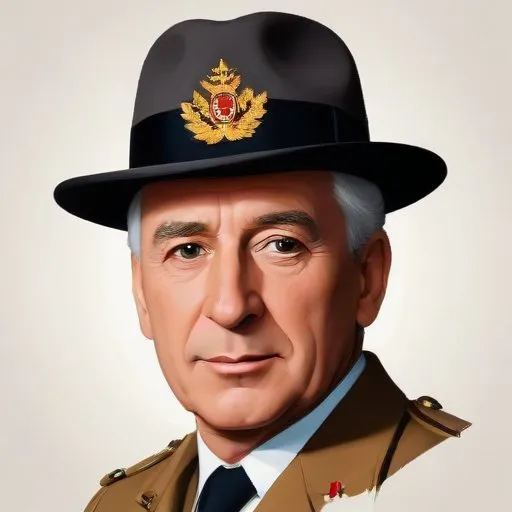
A Canadian military leader and statesman who served as the 19th Governor General of Canada, playing a key role in promoting national unity and bilingualism. He's revered for his dedication to Canadian identity and sovereignty.
Georges Philias Vanier is revered as a distinguished Canadian military officer and diplomat, best known for serving as the Governor General of Canada from 1959 to 1967. As the first Quebecer and second Canadian-born person to hold the position, Vanier left an indelible mark on the country's history.
Born on April 23, 1888, in the Little Burgundy neighborhood of Montreal, Vanier was raised in a bilingual household by his Irish mother, Margaret Maloney, and French-Norman father, Philias Vanier. He descended from a long line of Vaniers, who settled in Quebec City in the 17th century.
Vanier's military career spanned two World Wars, during which he demonstrated unwavering courage and dedication. In the First World War, he served on the European battlefields, losing a leg in combat. King George V commended his actions with several decorations.
After the war, Vanier transitioned to diplomatic circles, serving in missions across Europe. His experience and diplomatic prowess earned him recognition, leading to his appointment as Governor General of Canada in 1959.
Vanier's tenure as Governor General was marked by his commitment to promoting unity and national identity. As a Quebecer, he faced hostility from Quebec separatists, but his war record and diplomatic expertise earned him respect from the majority of Canadians.
Georges Vanier's legacy extends far beyond his governor generalship. He played a crucial role in shaping Canada's diplomatic relations, promoting bilingualism, and celebrating Canadian diversity. His dedication to public service and his country's well-being continue to inspire generations of Canadians.
"We must always remember that we are Canadians, and that our country is our common heritage."
Georges Vanier's remarkable life serves as a testament to his unwavering dedication to Canada and its people. As a champion of diplomacy, unity, and public service, he continues to inspire Canadians to strive for excellence and serve their country with pride.
Born in 1882
The 12th Prime Minister of Canada, a strong leader who played a crucial role in shaping the country's post-war economy and foreign policy, and is credited with establishing universal hospital insurance and old-age pensions.
Born in 1897
A Canadian leader who served as Prime Minister and won the Nobel Peace Prize for resolving the Suez Canal Crisis, known for his diplomatic efforts and peacekeeping initiatives.
Born in 1887
The 18th Governor General of Canada, a lawyer and politician who played a significant role in shaping Canada's cultural and national identity, particularly through his efforts to promote Canadian autonomy and unity. He is also known for his contributions to the development of Canada's national broadcasting system.
Born in 1912
A Canadian lawyer and politician who served as the 11th Premier of Quebec, known for modernizing the province's economy and education system. He led the Quiet Revolution, a period of significant social and political change in Quebec.
Born in 1919
The charismatic leader who championed Canadian unity and implemented progressive policies, known for his iconic style and influential legacy in shaping modern Canada.
Born in 1922
A charismatic leader who championed Quebec's independence and shaped the province's distinct identity through his passionate politics and journalism. He's revered for his role in Quebec's Quiet Revolution.
87 Years Old
The 18th Prime Minister of Canada, a skilled lawyer and politician, led the country from 1984 to 1993, known for negotiating the Canada-US Free Trade Agreement and introducing the Goods and Services Tax.
79 Years Old
The first and only female Prime Minister of Canada, serving for a brief four months in 1993, known for her efforts to reform the country's justice system. She was also a strong advocate for women's rights and gender equality.
