


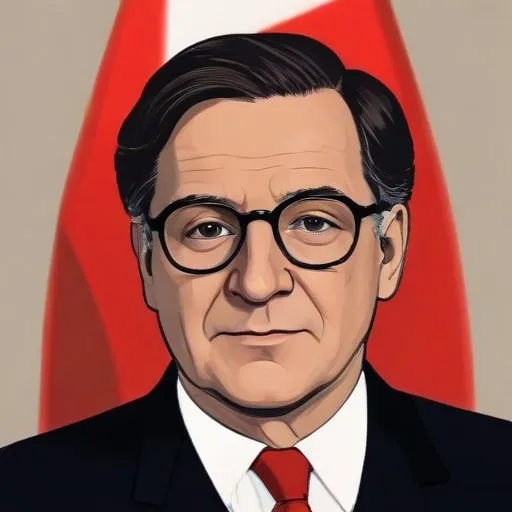
The 12th Prime Minister of Canada, a strong leader who played a crucial role in shaping the country's post-war economy and foreign policy, and is credited with establishing universal hospital insurance and old-age pensions.
Louis St. Laurent, the 12th Prime Minister of Canada, is renowned for his steadfast leadership during the post-war era, championing anti-communist ideologies, and steering the country through significant economic and infrastructure developments. His tenure, spanning from 1948 to 1957, was marked by two consecutive landslide victories, earning him the nickname "Uncle Louis" among the Canadian populace.
Born on February 1, 1882, in Saint-Laurent, Quebec, St. Laurent was raised in a predominantly French-Canadian community. He pursued a career in law, becoming a leading lawyer in the region. His involvement with the Liberal Party of Canada began in 1941, when he was appointed Minister of Justice under Prime Minister William Lyon Mackenzie King.
In 1942, St. Laurent won a byelection in Quebec East, solidifying his presence in Canadian politics. Four years later, he became Secretary of State for External Affairs, serving until 1948. It was during this period that he succeeded King as the leader of the Liberal Party and Prime Minister of Canada.
Despite his popularity, St. Laurent's government was narrowly defeated by the Progressive Conservatives in the 1957 federal election. Following his defeat, he retired from politics and returned to his law practice. St. Laurent passed away on July 25, 1973, leaving behind a legacy as one of Canada's most notable prime ministers.
St. Laurent's leadership coincided with a period of significant global change, marked by the rise of the Cold War and decolonization. His commitment to anti-communist ideologies and international cooperation positioned Canada as a key player in global affairs. In comparison to his contemporaries, St. Laurent's leadership style was characterized by his calm and measured approach, earning him the respect of his peers.
Louis St. Laurent's enduring legacy is a testament to his unwavering commitment to Canadian values and his pivotal role in shaping the country's post-war trajectory.
Born in 1897
A Canadian leader who served as Prime Minister and won the Nobel Peace Prize for resolving the Suez Canal Crisis, known for his diplomatic efforts and peacekeeping initiatives.
Born in 1919
The charismatic leader who championed Canadian unity and implemented progressive policies, known for his iconic style and influential legacy in shaping modern Canada.
92 Years Old
The 20th Prime Minister of Canada, serving from 1993 to 2003, known for his leadership during the Quebec sovereignty movement and his role in shaping Canada's national unity. He implemented policies like the Clarity Act and the National Child Benefit.
45 Years Old
American professional ice hockey player who won two Stanley Cup championships and was a four-time NHL All-Star. Known for his rugged defensive play and physical presence on the ice.
Born in 1874
The tenth Prime Minister of Canada, serving for a record 22 years, is most known for leading the country through significant periods of economic and social change, including the Great Depression and World War II.
Born in 1870
The 11th Prime Minister of Canada, a lawyer-turned-politician who led the country through the Great Depression, implementing policies to alleviate economic suffering. He's known for his efforts to establish a Canadian welfare state.
Born in 1895
The 13th Prime Minister of Canada, a champion of individual rights and freedoms, introduced the Canadian Bill of Rights, a precursor to the Charter of Rights and Freedoms. He's also known for his anti-apartheid stance and leadership during the Suez Crisis.
97 Years Old
The 17th Prime Minister of Canada, serving from 1984 to 1985, is most known for his brief tenure and struggles to maintain party unity. He's also recognized for his prior role as Minister of Justice, where he introduced significant reforms.
