


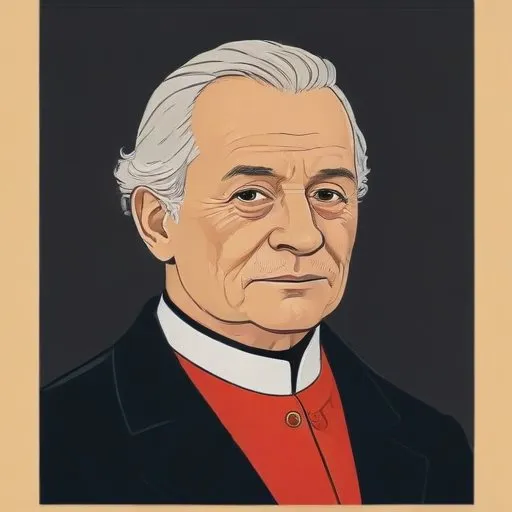
A pioneering linguist and sinologist who deciphered and translated ancient Chinese texts, making significant contributions to the field of Chinese language and literature studies.
Georg von der Gabelentz is renowned for his monumental work, Chinesische Grammatik, published in 1881, which remains to this day the most comprehensive and authoritative grammatical survey of Classical Chinese. This magnum opus has solidified his position as a luminary in the field of sinology and linguistics.
Born on March 16, 1840, in Poschwitz, near Altenburg, Saxe-Altenburg, Georg von der Gabelentz was the son of Hans Conon von der Gabelentz, a minister, and linguist. He demonstrated a prodigious talent for languages, teaching himself Dutch, Italian, and Chinese during his gymnasium years. Following in his father's footsteps, he studied law, administration, and linguistics at Jena from 1860 to 1864.
In 1878, the University of Leipzig created the first professorship of Far Eastern Languages in the German-speaking world, and Gabelentz was invited to fill this esteemed position. During his tenure, he mentored a range of prominent scholars, including Wilhelm Grube, Johann Jakob Maria de Groot, Arthur von Rosthorn, Karl Florenz, and Max Uhle. His students went on to become leading authorities in their respective fields, a testament to Gabelentz's pedagogical prowess.
In 1876, he earned his doctoral degree from Dresden with a translation of Zhou Dunyi's Taiji Tushuo, a seminal work on the concept of Taiji. This achievement marked a significant milestone in his academic career, demonstrating his mastery of classical Chinese texts.
Gabelentz's publishing oeuvre is characterized by its breadth and depth. In 1891, he published Die Sprachwissenschaft, a comprehensive treatise on linguistics. The following year, he released Handbuch zur Aufnahme fremder Sprachen, a handbook on the acquisition of foreign languages.
Gabelentz was critical of the Beijing dialect, which dominated the linguistic scene in China during his lifetime. Instead, he advocated for the recognition of other Chinese dialects, believing them to be more suitable for scientific inquiry. This stance reflects his commitment to a more nuanced understanding of the Chinese language.
Gabelentz's contributions to sinology and linguistics have left an indelible mark on the academic landscape. His work continues to influence contemporary scholars, who draw upon his insights to inform their own research. As a pioneer in the field of Far Eastern languages, Gabelentz's legacy serves as a testament to the power of dedicated scholarship and intellectual curiosity.
Gabelentz married Alexandra von Rothkirch in 1872 and later divorced in 1889. He remarried in 1891. His father, Hans Conon von der Gabelentz, passed away in 1874 at the family castle of Lemnitz.
Gabelentz's remarkable life and career are a testament to his unwavering passion for languages and his unrelenting pursuit of knowledge. His contributions continue to shape our understanding of the Chinese language and its cultural significance.
Born in 1857
Developed the foundation of modern linguistics, introducing concepts like signs, signifiers, and structuralism, revolutionizing the study of language and its role in shaping culture.
Born in 1746
A pioneer in comparative linguistics, deciphering ancient scripts, and founding the Asiatic Society, he's renowned for discovering the Indo-European language family.
Born in 1896
A pioneering linguist and theorist who developed groundbreaking concepts in phonology, morphology, and semiotics, shaping modern linguistics and literary theory.
