


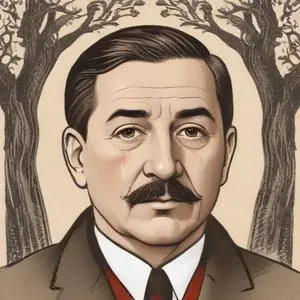
Developed the foundation of modern linguistics, introducing concepts like signs, signifiers, and structuralism, revolutionizing the study of language and its role in shaping culture.
Ferdinand de Saussure, a Swiss linguist, semiotician, and philosopher, is widely regarded as one of the founders of 20th-century linguistics and semiotics. He laid the foundation for significant developments in both fields, and his ideas continue to influence contemporary approaches to language and human sciences.
Saussure was born on November 26, 1857, in Geneva, Switzerland, to Henri Louis Frédéric de Saussure, a mineralogist, entomologist, and taxonomist. Showing exceptional talent and intellectual ability from an early age, Saussure began attending the Institution Martine in Geneva at 14, where he lived with a classmate's family.
After graduating at the top of his class, Saussure's father sent him to the Collège de Genève instead of the Gymnase de Genève, which Saussure had been looking forward to attending. He spent a year at the college, but was not pleased with his experience, feeling that he had "wasted a year" there.
Saussure's most significant work, Cours de linguistique générale (Course in General Linguistics), published posthumously in 1916, introduced the concept of signifier and signified, which revolutionized the field of linguistics. He also developed the concept of langue, the social system of language, and parole, individual instances of language use.
Saussure's philosophical contributions centered around the idea that language is a system of signs, and that meaning is created through the relationships between these signs. He believed that language is a social construct, and that our understanding of reality is shaped by the language we use.
Saussure's personal life was marked by a deep sense of dedication to his work and a struggle with mental health issues. He suffered from depression and anxiety, which often hindered his ability to work.
Ferdinand de Saussure's work has had a lasting impact on modern linguistics and semiotics. His ideas continue to influence contemporary thought, and his legacy extends beyond the realm of academia, shaping our understanding of language and its role in shaping our perception of reality.
As Leonard Bloomfield once said, "He has given us the theoretical basis for a science of human speech."
Born in 1858
A founder of modern sociology, known for establishing the field and exploring the relationships between individuals and society, particularly in his work "Suicide".
Born in 1872
A pioneering sociologist and anthropologist who developed the concept of "gift economy" and explored the social significance of exchange and reciprocity in human societies.
97 Years Old
Developed groundbreaking theories on language acquisition and universal grammar, and is a prominent critic of power and propaganda in modern society.
Born in 1896
A pioneering linguist and theorist who developed groundbreaking concepts in phonology, morphology, and semiotics, shaping modern linguistics and literary theory.
Born in 1918
A prominent 20th-century philosopher who developed the concept of "ideological state apparatuses" and reinterpreted Marxism, influencing modern social and political thought.
99 Years Old
A French historian and philosopher who critiqued power structures and social norms, arguing that knowledge and truth are shaped by those in power. He's known for his concepts of power, discipline, and surveillance.
Born in 1915
A French philosopher, theorist, and critic who challenged traditional notions of culture, literature, and identity through his influential writings on semiotics, mythology, and structuralism. He's most known for his critical theories on modern society and culture.
96 Years Old
A pioneer of poststructuralism, deconstructing traditional notions of meaning and challenging Western philosophy's core assumptions. His work redefined the way we think about language, culture, and identity.
