


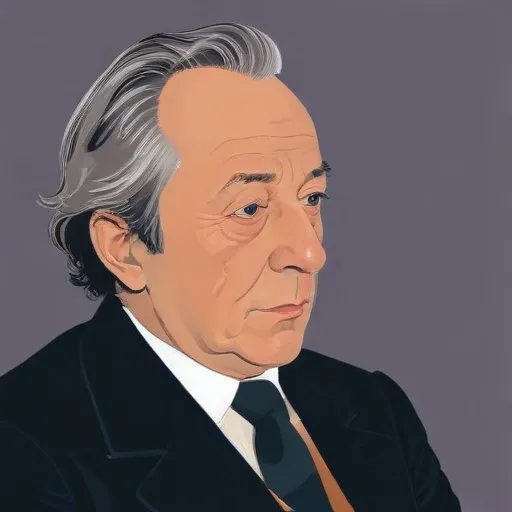
A prominent 20th-century philosopher who developed the concept of "ideological state apparatuses" and reinterpreted Marxism, influencing modern social and political thought.
Louis Althusser, a prominent French Marxist philosopher, is known for his critical contributions to Marxist theory and his influence on modern social thought. His work challenged the traditional Marxist ideology and introduced a new structuralist approach to understanding society, earning him the label of a "structural Marxist."
Althusser was born on October 16, 1918, in Birmendre, French Algeria, to a petit-bourgeois family from Alsace, France. His family moved to Marseille in 1930, where he spent his formative years. Althusser pursued higher education at the École Normale Supérieure in Paris, where he eventually became a professor of philosophy.
In 1980, Althusser's life took a dramatic turn when he killed his wife, Hélène Rytman, a sociologist, by strangling her. He was declared unfit to stand trial due to insanity and was committed to a psychiatric hospital for three years.
Althusser's most influential works include:
Althusser's ideas have influenced a wide range of fields, including:
Althusser's legacy is marked by both intellectual acclaim and personal controversy. While his contributions to Marxist theory are undeniable, his personal life was marred by periods of mental illness and the tragic event of his wife's death.
Despite these challenges, Althusser's ideas continue to inspire and provoke debate in academia and beyond. His structuralist approach to Marxism remains a vital component of modern social thought, ensuring his legacy as a prominent figure in 20th-century philosophy.
Born in 1905
Existentialist philosopher and playwright who argued that humans have complete freedom to choose their actions and create their own meaning in life, influencing modern thought on morality and individual responsibility.
Born in 1908
A French philosopher and academic who developed the concept of phenomenology, exploring the relationship between the self and the world, and is known for his work on perception, consciousness, and embodiment.
99 Years Old
A French historian and philosopher who critiqued power structures and social norms, arguing that knowledge and truth are shaped by those in power. He's known for his concepts of power, discipline, and surveillance.
96 Years Old
A French sociologist, anthropologist, and philosopher who developed the concept of "cultural capital" and critiqued social inequality, highlighting how power and privilege are maintained through cultural and symbolic means.
Born in 1924
A French philosopher, sociologist, and literary theorist who challenged traditional notions of knowledge, truth, and power, and is famous for his concept of "postmodernism".
Born in 1925
A French philosopher who developed influential concepts like "rhizome" and "desire-machines," which challenged traditional notions of identity, reality, and power.
96 Years Old
A French psychotherapist and philosopher who developed the concept of "schizoanalysis," a critical perspective on capitalism and its effects on desire and subjectivity. He's also known for his collaborations with Gilles Deleuze, particularly their influential book "A Thousand Plateaus."
Born in 1576
A 17th-century priest and glassmaker who pioneered glassmaking techniques and wrote the first comprehensive guide to glassmaking, "L'Arte Vetraria".
