


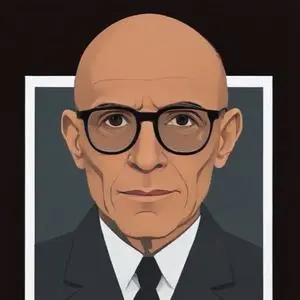
A French historian and philosopher who critiqued power structures and social norms, arguing that knowledge and truth are shaped by those in power. He's known for his concepts of power, discipline, and surveillance.
Born in 1905
Existentialist philosopher and playwright who argued that humans have complete freedom to choose their actions and create their own meaning in life, influencing modern thought on morality and individual responsibility.
Born in 1889
A German philosopher and academic who explored the meaning of existence, time, and human existence, influencing 20th-century philosophy with his concept of "Being-in-the-world".
Born in 1908
A pioneering feminist philosopher who wrote extensively on ethics, politics, and gender, famously arguing that "one is not born, but rather becomes, a woman."
96 Years Old
A pioneer of poststructuralism, deconstructing traditional notions of meaning and challenging Western philosophy's core assumptions. His work redefined the way we think about language, culture, and identity.
Born in 1915
A French philosopher, theorist, and critic who challenged traditional notions of culture, literature, and identity through his influential writings on semiotics, mythology, and structuralism. He's most known for his critical theories on modern society and culture.
Born in 1925
A French philosopher who developed influential concepts like "rhizome" and "desire-machines," which challenged traditional notions of identity, reality, and power.
96 Years Old
A French psychotherapist and philosopher who developed the concept of "schizoanalysis," a critical perspective on capitalism and its effects on desire and subjectivity. He's also known for his collaborations with Gilles Deleuze, particularly their influential book "A Thousand Plateaus."
Born in 1918
A prominent 20th-century philosopher who developed the concept of "ideological state apparatuses" and reinterpreted Marxism, influencing modern social and political thought.