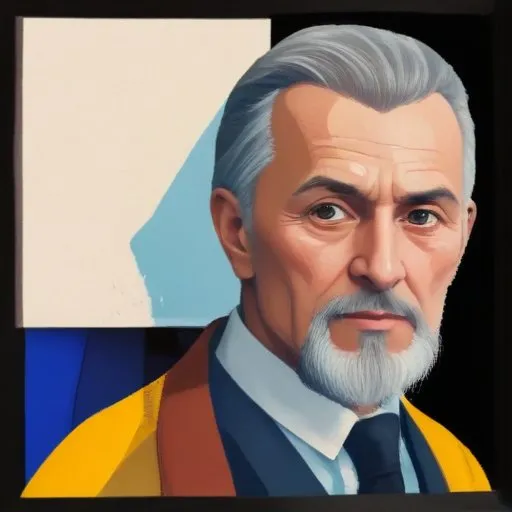
Georgy Voronoy: The Mathematical Genius Behind Voronoi Diagrams
A Life Dedicated to Mathematics
Georgy Voronoy, a Russian mathematician of Ukrainian descent, is renowned for defining the Voronoi diagram, a fundamental concept in mathematics that has far-reaching applications in various fields. Born on April 28, 1868, in Zhuravka, Pyriatyn, Voronoy's work has had a profound impact on the way we understand spatially distributed data.
Early Life and Education
Voronoy's academic journey began at Saint Petersburg University, where he studied under the guidance of
Andrey Markov, a prominent Russian mathematician. In 1894, Voronoy defended his master's thesis, "On algebraic integers depending on the roots of an equation of third degree," which marked the beginning of his illustrious career.
A Career Highlighted by Landmark Contributions
Voronoy's most notable achievement is the introduction of Voronoi diagrams, also known as tessellations. These diagrams, which are used to partition a plane into regions based on the proximity to a set of points, have become an essential tool in various scientific disciplines, including:
- Geophysics
- Meteorology
- Condensed matter physics
- Lie groups
His work on continued fractions, particularly his doctoral thesis, "On a generalisation of a continuous fraction," further solidified his reputation as a leading mathematician of his time.
Awards and Recognition
Voronoy's outstanding contributions to mathematics earned him recognition from the international community. In 1904, he was an Invited Speaker at the International Congress of Mathematicians (ICM) in Heidelberg, a prestigious honor bestowed upon the most esteemed mathematicians of the era.
Personal Struggles and Legacy
Despite his remarkable accomplishments, Voronoy's life was cut short due to health issues. He suffered from stomach problems, which eventually led to his untimely death on November 20, 1908, at the age of 40. In his diary, Voronoy expressed his fears about not being able to complete his work, stating, "I am so afraid that the results of my enduring efforts, obtained with such difficulty, will perish along with me."
Voronoy's legacy, however, did not perish with him. His pioneering work on Voronoi diagrams has continued to inspire generations of mathematicians and scientists, leaving an indelible mark on various fields of study.
Trivia and Fun Facts
- Voronoy was born in the Poltava Governorate, which is now part of Ukraine.
- He defended his doctoral thesis in the same year he became a professor at the University of Warsaw.
A Lasting Impact on Mathematics
Georgy Voronoy's remarkable story is a testament to the power of human ingenuity and the importance of pursuing one's passion, even in the face of adversity. His groundbreaking work on Voronoi diagrams has left a lasting impact on mathematics, and his legacy continues to inspire future generations of mathematicians and scientists.
FAQ
What was Georgy Voronoys role in mathematics?
Georgy Voronoy was a Ukrainian-Russian mathematician who made significant contributions to the field of number theory, including the development of the Voronoy diagram.
What was Georgy Voronoys early life and education like?
Georgy Voronoy was born in Ukraine in 1868 and studied mathematics at the University of St. Petersburg.
How did Georgy Voronoys work impact computer science and geometry?
Georgy Voronoys work had a significant impact on computer science and geometry, as his development of the Voronoy diagram has been used in a wide range of applications, from computer graphics to geographic information systems.
What were Georgy Voronoys key achievements in mathematics?
Georgy Voronoys key achievements include the development of the Voronoy diagram, his work on the theory of numbers, and his contributions to the development of Russian mathematics.
How is Georgy Voronoy remembered in the field of mathematics?
Georgy Voronoy is remembered as a pioneering mathematician who made significant contributions to number theory and geometry, and whose work continues to influence mathematics and computer science today.