


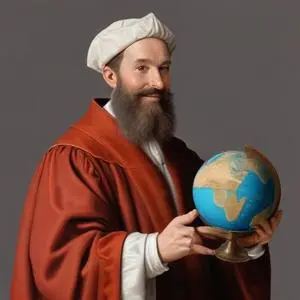
A Flemish mathematician, cartographer, and philosopher who developed the Mercator projection, a cylindrical map projection that preserves angles and shapes well, revolutionizing navigation and cartography.
Gerardus Mercator, a Flemish geographer, cosmographer, and cartographer, is renowned for creating the 1569 world map that revolutionized navigation by representing sailing courses of constant bearing as straight lines. This innovation, known as the Mercator projection, is still employed in nautical charts today, making him one of the most significant figures in the history of cartography.
Born on March 5, 1512, in Rupelmonde, Flanders, Mercator was raised in a family of modest means. Despite the financial constraints, his parents recognized his intellectual potential and encouraged his education. Mercator studied philosophy, theology, and mathematics at the University of Leuven, where he developed a deep passion for geography and cartography.
Mercator's most notable contribution to cartography is the development of the Mercator projection, a cylindrical map projection that preserves angles and shapes well, making it ideal for navigation. This innovation enabled sailors to chart their courses more accurately, reducing the risk of navigational errors and making maritime trade more efficient.
In addition to his work on the Mercator projection, he was a prolific cartographer, producing over 100 regional maps in a smaller format suitable for binding into his Atlas of 1595. This atlas was the first to use the term "Atlas" to describe a collection of maps, and it set a new standard for cartographic excellence.
Mercator was also a skilled instrument maker and globe manufacturer. His terrestrial and celestial globes were considered the finest in the world for over sixty years, and many surviving examples still exist today. His scientific instruments, such as astrolabes and astronomical rings, were used by scholars and astronomers to study the geometry of astronomy and astrology.
In 1552, Mercator moved to Duisburg, where he established a cartographic workshop and began to produce his famous maps and globes. He was appointed as the cosmographer to the Duke of Cleves in 1564, a position that allowed him to focus on his cartographic work.
Mercator married Barbara Schellekens in 1536, and they had six children together. His family life was marked by tragedy, with the loss of several children in infancy and early childhood.
Mercator's work had a profound impact on modern society, enabling the Age of Exploration and facilitating global trade. His maps and globes helped to shape our understanding of the world, and his innovative cartographic techniques continued to influence mapmaking for centuries.
Today, the Mercator projection remains an essential tool in navigation, and his legacy continues to inspire cartographers, geographers, and explorers around the world.
Mercator's life and work must be seen within the context of the Renaissance, a time of great intellectual and cultural upheaval. His contributions to cartography, geography, and astronomy reflect the spirit of curiosity and discovery that characterized this era.
As a legacy, Mercator's work has had a lasting impact on the development of geography, cartography, and navigation. His innovative approaches to mapmaking continue to inspire new generations of cartographers, and his name has become synonymous with excellence in cartography.
Gerardus Mercator's remarkable life and achievements continue to inspire and fascinate us today. His legacy is a testament to the power of human ingenuity and the importance of cartography in shaping our understanding of the world.
Born in 1527
A Flemish cartographer and geographer who created the first modern atlas, revolutionizing navigation and exploration. His work laid the foundation for modern cartography.
Born in 1495
A 16th-century mathematician and astronomer who calculated the distances of celestial bodies and created detailed astronomical charts, making significant contributions to the field of astronomy.
Born in 1452
Renaissance mastermind behind iconic works like the Mona Lisa and The Last Supper, who revolutionized art, science, and engineering with his inventive and curious nature.
