


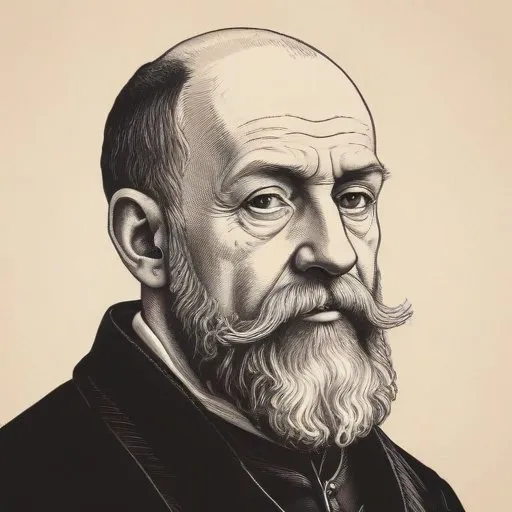
A Flemish cartographer and geographer who created the first modern atlas, revolutionizing navigation and exploration. His work laid the foundation for modern cartography.
Abraham Ortelius is renowned for creating the first modern atlas, the Theatrum Orbis Terrarum (Theatre of the World), which revolutionized the field of cartography in 1570. This masterpiece is considered the official beginning of the Golden Age of Netherlandish cartography, earning Ortelius a revered place in the history of geography and mapmaking.
Ortelius was born on either April 4 or 14, 1527, in Antwerp, Spanish Netherlands, to a family of merchants and pharmacists. His grandfather, Willem Ortels, was a pharmacist who had moved to Antwerp from Augsburg, a Free Imperial City of the Holy Roman Empire. Ortelius's family was fairly well off, and he received a good education, which would later serve as the foundation for his cartographic pursuits.
In 1564, Ortelius began working on his magnum opus, the Theatrum Orbis Terrarum, which would take him six years to complete. This atlas consisted of 53 maps, including 24 new ones created by Ortelius himself. The work was a groundbreaking achievement, as it brought together maps from various sources, standardized map projections, and introduced the concept of a "theatre of the world." The Theatrum Orbis Terrarum became an instant success, with over 30 editions published during Ortelius's lifetime.
Ortelius's atlas not only presented maps but also included descriptive texts, making it a comprehensive geographical work. He was the first to propose the idea of continental drift, suggesting that the continents were once joined together before drifting apart to their present positions. This concept was revolutionary for its time and would later influence Alfred Wegener's theory of plate tectonics.
Ortelius's work had a significant impact on navigation, trade, and exploration during the Age of Discovery. His maps and atlases facilitated the exchange of knowledge and ideas among scholars, traders, and explorers, contributing to the expansion of European empires and the discovery of new lands.
Abraham Ortelius is remembered as one of the founders of the Netherlandish school of cartography and geography, along with Gerardus Mercator and Gemma Frisius. His contributions to cartography and geography continue to influence modern scholarship, and his legacy is celebrated through the Ortelius crater on the Moon, named in his honor.
Today, Ortelius's work remains a testament to the power of human ingenuity and the importance of cartography in understanding our world.
Born in 1512
A Flemish mathematician, cartographer, and philosopher who developed the Mercator projection, a cylindrical map projection that preserves angles and shapes well, revolutionizing navigation and cartography.
Born in 1495
A 16th-century mathematician and astronomer who calculated the distances of celestial bodies and created detailed astronomical charts, making significant contributions to the field of astronomy.
Born in 1623
A Flemish Jesuit missionary who introduced European astronomy to China, making significant contributions to the country's scientific development. He's also credited with creating the first Chinese-language astronomical atlas.
Born in 1494
A Renaissance mathematician and cartographer who created intricate maps and developed new mathematical instruments, making significant contributions to the fields of astronomy and navigation.
Born in 1452
A 15th-century German mathematician and astronomer who calculated planetary positions and developed trigonometric tables, contributing significantly to the field of astronomy. His work influenced later astronomers like Copernicus and Regiomontanus.
