


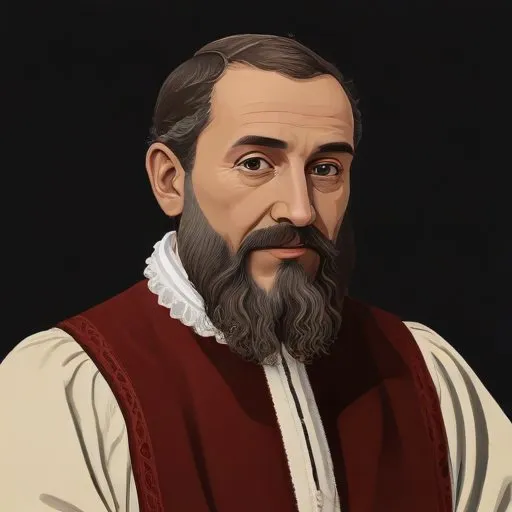
This 16th-century Renaissance polymath was a pioneer in probability theory, algebra, and cryptography, leaving an enduring mark on mathematics and science.
Gerolamo Cardano, an Italian genius, left an indelible mark on the world of mathematics, science, and philosophy. He is renowned for his groundbreaking contributions to algebra, probability, and mechanical engineering, cementing his position as one of the most influential minds of the Renaissance.
Born on September 24, 1501, in Pavia, Lombardy, Cardano was the illegitimate child of Fazio Cardano, a mathematically gifted jurist, and Chiara Micheri. Despite a tumultuous start to life, Cardano's natural aptitude for mathematics and science led him to pursue higher education at the University of Pavia, where he studied medicine and later earned his doctorate.
Cardano's magnum opus, Ars Magna (1545), revolutionized algebra by introducing negative numbers, publishing solutions for cubic and quartic equations, and acknowledging imaginary numbers. He also made significant strides in probability, laying the foundation for modern probability theory.
In addition, Cardano introduced the concept of binomial coefficients and the binomial theorem, which had a profound impact on Western mathematics. His work on hypocycloids, published in De proportionibus (1570), led to the development of high-speed printing presses.
A prolific inventor, Cardano designed and described several mechanical devices, including the combination lock, the gimbal (consisting of three concentric rings), and the Cardan shaft with universal joints. The latter innovation, still used in vehicles today, allows for the transmission of rotary motion at various angles.
Cardano's philosophical writings reflected his fascination with the mysteries of nature and the human condition. He believed in the concept of "fortunate unhappy events," where seemingly negative occurrences could ultimately lead to positive outcomes.
Throughout his life, Cardano faced numerous challenges, including financial struggles and personal scandals. However, he persevered, and his determination led to numerous milestones, including the publication of over 200 works on science, mathematics, and philosophy.
Cardano's legacy extends far beyond the Renaissance era. His contributions to algebra, probability, and mechanical engineering continue to inspire innovation and shape modern society.
Cardano's wisdom and wit are reflected in his quotes, such as:
Gerolamo Cardano's remarkable life and achievements serve as a testament to the power of human curiosity and determination. His legacy continues to inspire generations of mathematicians, scientists, and philosophers, solidifying his position as one of the most influential figures of the Renaissance.
As we reflect on Cardano's remarkable contributions, we are reminded that genius knows no bounds, and that the pursuit of knowledge and innovation can lead to a life of lasting impact and legacy.
Born in 1522
A 16th-century mathematician who solved the cubic equation, a fundamental problem in algebra, and was a professor at the University of Bologna. He also worked on quadratic and quartic equations.
Born in 1526
Developed algebraic methods to work with imaginary numbers, laying the groundwork for modern calculus and complex analysis.
Born in 1538
A 16th-century mathematician and astronomer who made significant contributions to the development of the Gregorian calendar and was a prominent figure in the scientific revolution of the time.
Born in 1546
A 16th-century astronomer who made precise measurements of the stars and planets, laying the foundation for modern astronomy. His data helped Kepler discover planetary orbits.
Born in 1564
Pioneering astronomer, physicist, and mathematician who played a major role in the Scientific Revolution, making key discoveries that challenged Aristotelian views and laid the foundation for modern science.
