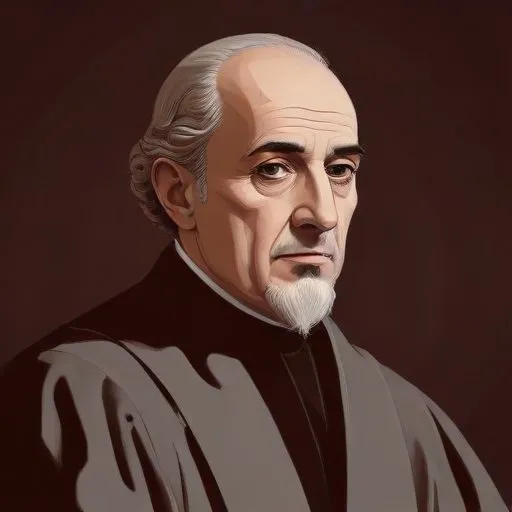
Giambattista Vico: The Italian Philosopher Who Redefined Human Knowledge
The Father of Modern Philosophy of History
Giambattista Vico, an Italian philosopher, rhetorician, historian, and jurist, is renowned for his groundbreaking contributions to the development of modern social science, semiotics, and the philosophy of history. His magnum opus,
Scienza Nuova (New Science), published in 1725, laid the foundation for a systematic organization of the humanities as a single science, recording and explaining the historical cycles by which societies rise and fall.
Early Life and Education
Born on June 23, 1668, in Naples, Italy, to a bookseller, Giovan Battista Vico's early life was marked by illness and dissatisfaction with the scholasticism of the Jesuits. He was educated at home by tutors, and his autobiographical work suggests that he was an autodidact, educated under paternal influence, during a three-year absence from school due to an accidental fall at the age of seven. Vico formally graduated from the University of Naples in 1694 as a Doctor of Civil Law.
Philosophical Contributions and Beliefs
Vico's philosophical contributions were marked by his criticism of modern rationalism, which he believed was impractical for human life. He advocated for classical antiquity and the Renaissance humanities, and his Latin aphorism,
Verum esse ipsum factum (truth is itself something made), is an early instance of constructivist epistemology. Vico's work in the philosophy of history attempted to provide a systematic organization of human knowledge, exploring the cyclical nature of societal development.
Influence on Modern Society
Vico's work has had a profound impact on modern society, influencing prominent thinkers such as
Isaiah Berlin,
Edward Said, and Hayden White. His philosophy of history has been applied to various fields, including sociology, anthropology, and cultural studies. Vico's emphasis on the importance of understanding human culture and society has shaped the way we approach historical research and analysis.
Major Works
- Scienza Nuova (New Science), 1725
- De Antiquissima Italorum Sapientia (On the Ancient Wisdom of the Italians), 1710
- Institutiones Oratoriae (Oratorical Institutions), 1711
Legacy and Historical Context
Vico's work is recognized as a precursor to modern intellectual movements, such as historicism and constructivism. He is regarded as one of the first Counter-Enlightenment figures in history, offering a unique perspective on human knowledge and societal development. Vico's legacy continues to influence contemporary thought, encouraging scholars to reexamine the nature of human culture and society.
Personal Milestones and Key Life Events
- 1694: Graduated from the University of Naples as a Doctor of Civil Law
- 1710: Published De Antiquissima Italorum Sapientia
- 1711: Published Institutiones Oratoriae
- 1725: Published Scienza Nuova
Trivia and Fun Facts
- Vico was known for his remarkable memory and was able to recall vast amounts of information from memory.
- He was heavily influenced by the works of ancient Greek philosophers, such as Plato and Aristotle.
- Vico's work was largely overlooked during his lifetime, but gained popularity in the 19th and 20th centuries.
FAQ
What was Giambattista Vicos contribution to philosophy?
Giambattista Vico was an Italian jurist, historian, and philosopher who made significant contributions to the fields of philosophy, history, and jurisprudence. His ideas on the cyclical nature of history and the importance of mythology are particularly notable.
What is Giambattista Vicos New Science?
Vicos New Science is a philosophical and historical work that outlines his ideas on the nature of history, the role of mythology, and the development of human societies. It is considered a major contribution to Enlightenment thought.
How did Giambattista Vicos ideas influence the Enlightenment?
Vicos ideas on history, mythology, and human development had a significant impact on Enlightenment thinkers, including Jean-Jacques Rousseau and Denis Diderot. His work helped shape the intellectual landscape of the 18th century.
What was Giambattista Vicos relationship with the University of Naples?
Vico was a professor of rhetoric at the University of Naples, where he taught for over 40 years. He played a key role in the universitys intellectual life and was a prominent figure in Neapolitan society.
What was Giambattista Vicos legacy?
Vicos legacy lies in his contributions to philosophy, history, and jurisprudence. He is remembered as one of the most important thinkers of the Enlightenment era.