


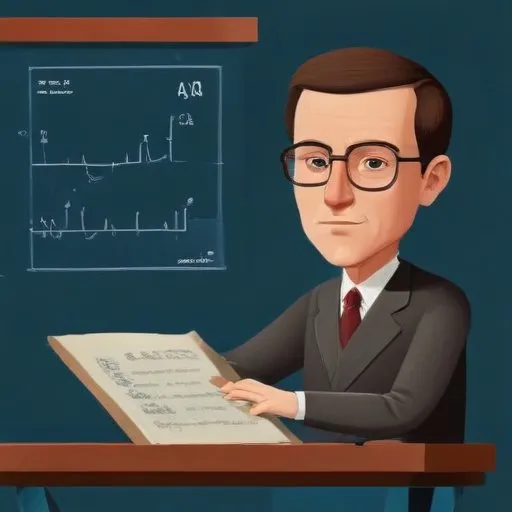
A renowned mathematician and educator, he is most known for his influential textbooks and online courses that have made linear algebra and calculus accessible to millions of students worldwide.
Gilbert Strang, an American mathematician, is renowned for his groundbreaking contributions to finite element theory, the calculus of variations, wavelet analysis, and linear algebra. His work has not only reshaped the landscape of mathematics education but has also made complex concepts accessible to a broader audience.
Born on November 27, 1934, in Chicago, Strang's parents, William and Mary Catherine, migrated from Scotland to the United States. Growing up in Washington D.C. and Cincinnati, Strang developed a passion for mathematics, which ultimately led him to pursue a degree in mathematics from the Massachusetts Institute of Technology (MIT). He graduated in 1955 and went on to receive a Rhodes Scholarship to the University of Oxford, where he earned his B.A. and M.A. from Balliol College in 1957.
Strang's contributions to mathematics education are unparalleled. He popularized the concept of the Fundamental Theorem of Linear Algebra, making it a cornerstone of mathematics education. His textbooks, which are widely used in universities and colleges, have been instrumental in shaping the minds of future mathematicians and scientists.
As the MathWorks Professor of Mathematics at MIT, Strang taught courses on Linear Algebra, Computational Science, Engineering, and Learning from Data. His lectures, which are freely available through MIT OpenCourseWare, have been viewed by millions of students worldwide, making him one of the most watched mathematics lecturers in the world.
Strang's approach to mathematics is centered around the idea that mathematics should be accessible to everyone, regardless of their background or expertise. He believes that mathematics is not just a subject, but a way of thinking, and that it should be taught in a way that fosters creativity, critical thinking, and problem-solving skills.
Strang married his wife, Jillian Shannon, in 1958, and they have three sons, David, John, and Robert. The Strangs describe themselves as a close-knit family, and their family life has been an essential part of Strang's journey as a mathematician and educator.
On May 15, 2023, Strang retired from MIT after giving his final Linear Algebra and Learning from Data lecture, marking the end of an era in mathematics education.
Strang's work has had a profound impact on modern society. His contributions to finite element theory and wavelet analysis have been instrumental in the development of various technologies, including medical imaging, computer-aided design, and data compression.
His work on linear algebra has also had a significant impact on machine learning and artificial intelligence, enabling the development of sophisticated algorithms and models that are used in a wide range of applications, from self-driving cars to virtual assistants.
Gilbert Strang's legacy extends far beyond his contributions to mathematics education. He has inspired generations of mathematicians and scientists, and his work continues to shape the landscape of mathematics education.
As a testament to his impact, Strang's lectures are still widely viewed, and his textbooks remain popular among students and educators alike. His influence on modern society is a reminder of the power of mathematics to shape our world and improve our lives.
Born in 1564
Pioneering astronomer, physicist, and mathematician who played a major role in the Scientific Revolution, making key discoveries that challenged Aristotelian views and laid the foundation for modern science.
Born in 1749
Developed nebular hypothesis of the origin of the solar system and formulated Laplace's equation, a fundamental concept in mathematics and physics. He's considered the founder of celestial mechanics.
Born in 1736
Developed calculus, number theory, and celestial mechanics, making significant contributions to the fields of mathematics and astronomy.
Born in 1777
A pioneer in mathematics and physics, he made major contributions to number theory, algebra, and electromagnetism, shaping our understanding of the natural world.
Born in 1862
A renowned mathematician and academic who developed infinite-dimensional vector spaces and laid the foundation for quantum mechanics and relativity. He's also famous for his 23 unsolved math problems that shaped 20th-century mathematics.
