


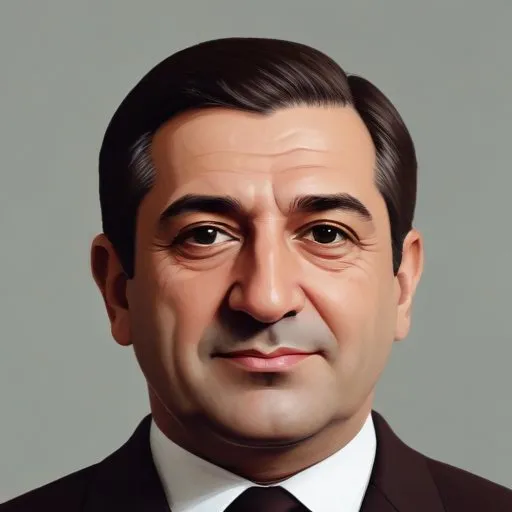
The 4th President of Georgia, an academic and politician, served from 2013 to 2018, known for his efforts to strengthen democracy and European integration in Georgia. He's also a philosopher and professor.
Giorgi Margvelashvili is renowned as the fourth president of Georgia, serving from 2013 to 2018, and is distinguished as the first president in the country's history not to seek reelection for a second term. As a philosopher-turned-politician, Margvelashvili's presidency was marked by his commitment to moderation and his vocal criticism of the consolidation of power by the ruling Georgian Dream party.
Born on September 4, 1969, in Tbilisi, Georgia, Margvelashvili hails from a family of intellectuals. His father, Teimuraz Margvelashvili, was an engineer, and his mother, Mzeana Gomelauri, a psychologist. He graduated from the Tbilisi State University in 1992 with a degree in philosophy, laying the foundation for his future academic pursuits.
Margvelashvili's postgraduate education took him to the Central European University in Budapest, Hungary (1993-1994), and the Institute of Philosophy, Georgian Academy of Sciences (1993-1996). He earned his doctorate in philosophy from the Tbilisi State University in 1998.
Before entering politics, Margvelashvili worked as a mountain guide at the Caucasus Travel agency in the early 1990s. He later became the rector of the Georgian Institute of Public Affairs, serving two non-consecutive terms from 2000 to 2006 and again from 2010 to 2012.
In October 2012, Margvelashvili joined the newly formed cabinet of Bidzina Ivanishvili as Minister of Education and Science of Georgia. He was subsequently appointed as First Deputy Prime Minister in February 2013.
In May 2013, the Georgian Dream coalition, led by Ivanishvili, named Margvelashvili as their presidential candidate. He won the October 2013 presidential election with an impressive 62% of the votes, marking a significant shift in Georgia's political landscape.
With Margvelashvili's election, a new constitution came into effect, significantly curtailing the president's powers in favor of the Prime Minister and the Parliament. This constitutional reform aimed to strengthen the country's democratic institutions.
During his presidency, Margvelashvili positioned himself as a voice of moderation, advocating for a balanced approach to governance. He criticized the Georgian Dream party's consolidation of power, sparking tensions with Ivanishvili and the party leadership.
Despite the challenges, Margvelashvili remained committed to his core values, prioritizing the country's democratic development and international cooperation.
Giorgi Margvelashvili's presidency has been marked by his commitment to democratic principles and his willingness to challenge the status quo. As the first president not to seek reelection, he has set a precedent for peaceful transitions of power in Georgia.
His legacy extends beyond his presidency, shaping the country's academic and political landscape. Through his work, Margvelashvili has inspired a new generation of Georgian leaders to prioritize moderation, critical thinking, and democratic values.
Giorgi Margvelashvili's remarkable journey, from philosopher to president, serves as a testament to the power of education and the importance of moderation in politics. His legacy continues to shape Georgia's political landscape, inspiring future generations of leaders to prioritize democratic values and critical thinking.
58 Years Old
The 3rd President of Georgia, a lawyer-turned-politician who spearheaded democratic reforms and fought against corruption, leading to a brief war with Russia. He's known for his bold anti-corruption efforts and tumultuous presidency.
98 Years Old
A Georgian politician who served as the country's second president, known for his role in ending the Cold War and introducing democratic reforms to Georgia.
95 Years Old
The last leader of the Soviet Union, who introduced reforms that led to the end of the Cold War and the collapse of communism, earning a Nobel Peace Prize. He's known for his policies of glasnost and perestroika, which transformed the Soviet Union and the world.
