


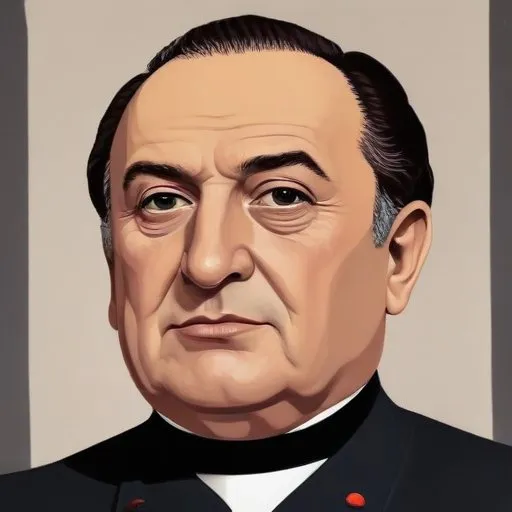
A Georgian politician who served as the country's second president, known for his role in ending the Cold War and introducing democratic reforms to Georgia.
Shevardnadze's political career began in the late 1940s as a leading member of the Komsomol organization in Georgia. He quickly rose through the ranks, becoming the First Secretary of the Georgian Communist Party in 1972, a position that made him the de facto leader of Georgia.
During his tenure, Shevardnadze implemented several economic reforms, which led to unprecedented economic growth in Georgia, a rare occurrence in the Soviet Union at the time. His anti-corruption campaign also earned him recognition, and he became known for his efforts to purge the government of corrupt officials.
In 1985, Mikhail Gorbachev appointed Shevardnadze as the Minister of Foreign Affairs, a position he held until the fall of the Soviet Union. During this time, Shevardnadze played a crucial role in shaping Soviet foreign policy, including the withdrawal of Soviet troops from Afghanistan and the signing of several key arms control agreements.
Shevardnadze's diplomatic efforts also helped to ease tensions between the Soviet Union and the West, paving the way for the eventual collapse of the Soviet Union and the end of the Cold War.
In 1992, Shevardnadze became the President of Georgia, a position he held until his resignation in 2003. During his presidency, Georgia faced several challenges, including a civil war and economic instability.
Shevardnadze's leadership during this period was marked by controversy, with some critiquing his handling of the civil war and his role in suppressing opposition movements.
Shevardnadze's legacy is complex and multifaceted. While he played a significant role in ending the Cold War and shaping Soviet foreign policy, his presidency was also marked by controversy and criticism.
Despite this, Shevardnadze's impact on modern society cannot be overstated. He played a crucial role in shaping the course of international relations and paved the way for the collapse of the Soviet Union.
"The time of blinkered, isolated, and inward-looking policies is over. The time of international cooperation, mutual understanding, and collective security has begun."
These words, spoken by Shevardnadze in 1988, reflect his commitment to democratic reform and his vision for a more cooperative international community.
Shevardnadze's life and career spanned a tumultuous period in world history, from the Cold War to the fall of the Soviet Union. His actions and decisions had far-reaching consequences, shaping the course of international relations and paving the way for a new era of global cooperation.
As the last Soviet Minister of Foreign Affairs, Shevardnadze's legacy is complex and multifaceted, reflecting both his achievements and his controversies. Despite this, his contributions to international relations and his commitment to democratic reform remain an important part of his enduring legacy.
95 Years Old
The last leader of the Soviet Union, who introduced reforms that led to the end of the Cold War and the collapse of communism, earning a Nobel Peace Prize. He's known for his policies of glasnost and perestroika, which transformed the Soviet Union and the world.
95 Years Old
First President of Russia, leading the country's transition from communism to democracy, and known for his bold reforms and iconic leadership style.
74 Years Old
A Russian politician who has dominated the country's politics for over two decades, known for his authoritarian leadership style and controversial foreign policy decisions.
87 Years Old
First President of Georgia, leading the country to independence from the Soviet Union, and known for his nationalistic and democratic reforms.
58 Years Old
The 3rd President of Georgia, a lawyer-turned-politician who spearheaded democratic reforms and fought against corruption, leading to a brief war with Russia. He's known for his bold anti-corruption efforts and tumultuous presidency.
52 Years Old
A Georgian colonel-turned-politician who served as Defense Minister, known for his efforts to modernize the country's military and strengthen ties with NATO. He played a key role in Georgia's bid to join the Western military alliance.
57 Years Old
The 4th President of Georgia, an academic and politician, served from 2013 to 2018, known for his efforts to strengthen democracy and European integration in Georgia. He's also a philosopher and professor.
