


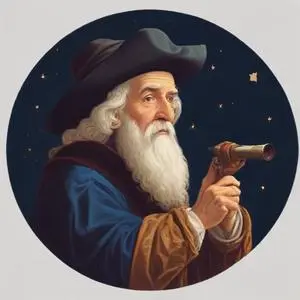
Mapped the heavens, discovering four moons of Saturn and the gap in Saturn's rings, making significant contributions to our understanding of the solar system.
Giovanni Domenico Cassini, a 17th-century Italian mathematician, astronomer, and engineer, is renowned for his groundbreaking discoveries in the field of astronomy, particularly his identification of four satellites of Saturn and the division of its rings, now famously known as the Cassini Division. This illustrious scientist is also credited with pioneering the project of creating a topographic map of France, leaving an indelible mark on the annals of scientific history.
Cassini was born on June 8, 1625, in Perinaldo, near Imperia, in the County of Nice, which was then part of the Savoyard state. His father, Jacopo Cassini, was a Tuscan, and his mother, Giulia Crovesi, instilled in him a passion for learning from a young age.
In 1648, Cassini accepted a position at the observatory at Panzano, near Bologna, to work with Marquis Cornelio Malvasia, a wealthy amateur astronomer. This opportunity allowed him to complete his education under the guidance of prominent scientists Giovanni Battista Riccioli and Francesco Maria Grimaldi.
In 1650, the senate of Bologna appointed Cassini as the principal chair of astronomy at the University of Bologna. During his tenure, he observed and wrote a treatise on the comet of 1652, showcasing his exceptional astronomical skills.
Cassini's expertise extended beyond astronomy; he was also employed by the senate of Bologna as a hydraulic engineer and was later appointed by Pope Alexander VII as inspector of fortifications in 1657. He subsequently became the director of waterways in the papal states.
In San Petronio, Bologna, Cassini convinced church officials to create an improved sundial meridian line at the San Petronio Basilica. By moving the pinhole gnomon that projected the Sun's image up into the church's vaults, 66.8 meters away from the meridian inscribed in the floor, he was able to measure the change in the Sun's diameter throughout the year.
In 1997, the Cassini space probe was launched, named in honor of this Italian astronomer. This spacecraft became the fourth to visit Saturn and the first to orbit it, perpetuating Cassini's legacy in the field of astronomy.
Giovanni Domenico Cassini's remarkable journey, marked by groundbreaking discoveries and contributions to various fields, has left an indelible mark on the annals of scientific history. His work continues to inspire generations of scientists, engineers, and astronomers, illuminating the skies with the brightness of his legacy.
Born in 1678
French geophysicist and astronomer who studied the Earth's magnetic field and discovered the daily variation of the magnetic declination, making significant contributions to the field of geophysics. He also made observations on the aurora borealis and its connection to the Earth's magnetic field.
Born in 1656
Predicted celestial events, including the return of a comet that bears his name, and made significant contributions to navigation, astronomy, and mathematics.
Born in 1629
A 17th-century polymath who made groundbreaking contributions to optics, probability theory, and astronomy, including the discovery of Saturn's rings and the largest moon, Titan.
Born in 1644
Danish astronomer and instrument maker who made the first quantitative measurements of the speed of light and contributed to the development of telescopes and other astronomical instruments.
