


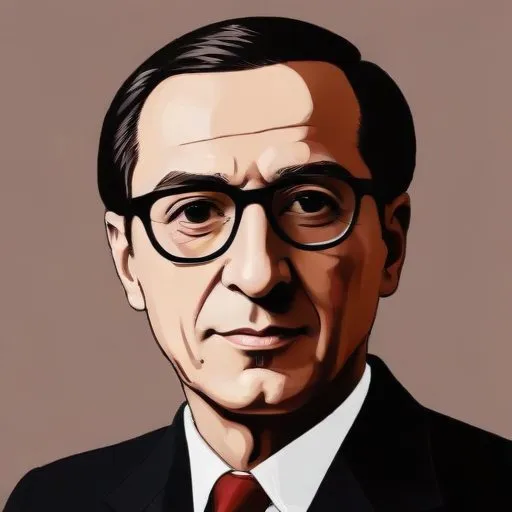
Italian journalist and author, best known for creating the beloved character Don Camillo, a wise and witty priest, in a series of humorous short stories and novels. His works are considered classics of Italian literature.
Giovannino Guareschi, an Italian journalist, cartoonist, and humorist, is best known for creating the beloved character of Don Camillo, a priest with a heart of gold and a penchant for getting into humorous misadventures. Through his satirical writings and cartoons, Guareschi brought laughter and joy to millions, while also shedding light on the complexities of Italian politics and society.
Born on May 1, 1908, in Fontanelle di Roccabianca, Parma, Guareschi grew up in a middle-class family. After his family's financial struggles forced him to abandon his university studies, he began working as a journalist for the local newspaper, Gazzetta di Parma. His wit and humor soon caught the attention of editors, and he became the editor of the satirical magazine Corriere Emiliano in 1929.
During World War II, Guareschi's satirical writings took on a new tone, as he used humor to criticize the fascist regime. It was during this time that he created Don Camillo, a character that would become synonymous with Italian humor. The stories of Don Camillo, a well-meaning but hot-headed priest, and his nemesis, Peppone, the communist mayor, captivated readers and brought a much-needed respite from the war.
After the war, Guareschi founded the monarchist weekly satirical magazine Candido, where he continued to lampoon Italian politics. He was critical of both the Christian Democracy party and the Italian Communist Party, never afraid to voice his opinions through satire. One of his most famous cartoons depicted a communist with an extra nostril, poking fun at the party's ideology.
Guareschi's writings and cartoons had a profound impact on Italian society, offering a unique perspective on politics and culture. His critics praised his ability to use humor to dissect complex issues, making him a beloved figure in Italian literary and political circles. Today, his work remains a testament to the power of satire and its ability to inspire change.
"Inside the voting booth, God can see you, Stalin can't."
This quote, coined by Guareschi, became a popular slogan during the 1948 Italian general election, highlighting the importance of individual freedom and choice.
Guareschi's work continues to inspire generations of writers, cartoonists, and humorists. His unique blend of satire and humor has left an indelible mark on Italian culture, making him one of the most beloved and revered figures in Italian literary history.
Guareschi received numerous awards and honors for his work, including the prestigious Premio Marzotto for his contributions to Italian literature and culture.
Giovannino Guareschi passed away on July 22, 1968, but his legacy lives on through his work. As a humorist, journalist, and cartoonist, he left an indelible mark on Italian culture, inspiring generations to come.
94 Years Old
A renowned Italian intellectual who wrote bestselling novels like "The Name of the Rose" and "Foucault's Pendulum", blending mystery, history, and philosophy, while also being a prominent literary critic and philosopher.
Born in 1923
A renowned Italian writer, celebrated for his imaginative and philosophical fiction, often blending fantasy and reality, leaving a lasting impact on modern literature.
Born in 1919
An Italian chemist and author who survived Auschwitz and wrote powerful memoirs about his experiences, including "If This Is a Man" and "The Truce".
Born in 1908
An Italian poet and novelist who explored themes of existentialism, morality, and the human condition through his lyrical and introspective writing, leaving a lasting impact on 20th-century literature.
Born in 1896
A renowned Italian poet and translator, celebrated for his unique and expressive style that explores the human condition, earning him the Nobel Prize in Literature.
Born in 1916
A renowned Italian literary figure, celebrated for his poignant and evocative works that explored the Jewish-Italian experience during World War II, particularly in his acclaimed novel "The Garden of the Finzi-Continis".
