


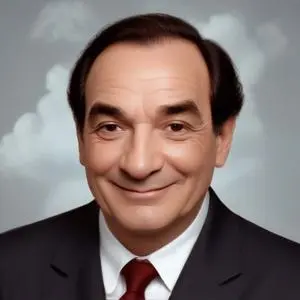
A renowned Italian writer, celebrated for his imaginative and philosophical fiction, often blending fantasy and reality, leaving a lasting impact on modern literature.
Italo Calvino is renowned for his innovative and imaginative literary works that defied genres and explored the intersection of fiction, philosophy, and science. His most famous works include the Our Ancestors trilogy, the Cosmicomics collection of short stories, and the novels Invisible Cities and If on a winter's night a traveler, which have been widely translated and admired globally.
Born on October 15, 1923, in Santiago de las Vegas, a suburb of Havana, Cuba, Calvino was the son of Mario Calvino, a tropical agronomist and botanist, and Eva Mameli, a botanist and university professor. His father's work led the family to move to Italy, where Calvino spent most of his childhood.
Calvino's parents, both secular and educated, instilled in him a love for science, literature, and civic duty. His father, a former anarchist and socialist reformist, exposed Calvino to the works of Kropotkin, while his mother's pacifist values shaped his worldview.
Calvino's literary career began in the 1940s, during which he wrote for several newspapers and magazines. His early works were influenced by Italian Neorealism, but he soon developed his unique style, blending fantasy, science fiction, and philosophical inquiry.
Calvino's works are characterized by their philosophical depth and inquiry. He was deeply interested in the nature of reality, the role of the individual in society, and the relationship between language and meaning.
Calvino was influenced by the works of philosophers such as Immanuel Kant, Ludwig Wittgenstein, and Roland Barthes, and his own philosophical contributions have been recognized for their originality and insight.
Calvino's works have inspired countless writers, artists, and thinkers across the globe. His innovative storytelling techniques and philosophical inquiry have influenced the development of postmodern literature and fiction.
His works have also been adapted into various forms of media, including film, theater, and music, further cementing his impact on popular culture.
Calvino received numerous awards and honors for his contributions to literature, including the Premio Campiello, the Premio Feltrinelli, and the World Fantasy Award for Life Achievement.
He was also elected as a member of the Italian Academy of the Arts and Sciences, and was awarded an honorary degree from the University of Rome.
Italo Calvino's passing on September 19, 1985, marked the loss of a literary giant, but his works continue to inspire and influence new generations of readers and writers.
As a writer, Calvino was deeply rooted in the cultural and historical context of his time, yet his works transcended the boundaries of genre and era, making him a truly visionary figure in world literature.
94 Years Old
A renowned Italian intellectual who wrote bestselling novels like "The Name of the Rose" and "Foucault's Pendulum", blending mystery, history, and philosophy, while also being a prominent literary critic and philosopher.
Born in 1919
An Italian chemist and author who survived Auschwitz and wrote powerful memoirs about his experiences, including "If This Is a Man" and "The Truce".
Born in 1899
A visionary writer who crafted intricate, philosophical tales that blurred reality and fantasy, influencing generations of authors and thinkers. 82
Born in 1920
Prolific author of poetic and imaginative science fiction, exploring the human condition through fantastical worlds and characters, with works adapted into films and TV shows.
Born in 1883
A writer of surreal, psychologically complex fiction that explores the human condition, often featuring isolated protagonists in absurd, nightmarish scenarios.
75 Years Old
A renowned Spanish writer and translator, known for his lyrical and introspective novels that explore the human condition, blending fiction and reality.
90 Years Old
A Nobel Prize-winning writer and politician who explored the complexities of Peruvian society through his novels and essays, and later ran for president. His works often blended politics, history, and fiction.
