


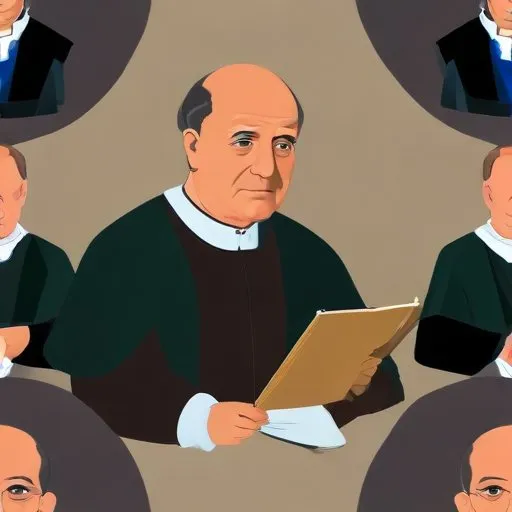
A Renaissance humanist who wrote extensively on ancient Greek music and its cultural significance, helping to shape the development of Western classical music.
Girolamo Mei, a 16th-century Italian historian and humanist, is renowned for providing the intellectual impetus to the Florentine Camerata, a group of visionaries who sought to revive ancient Greek music drama. Through his groundbreaking research and writings, Mei laid the foundations for the development of modern opera, leaving an indelible mark on the world of music.
Born in Florence in 1519, Mei was fascinated by the music of ancient Greece. He became the first European after Boethius to conduct a detailed study of ancient Greek music theory, pouring over ancient texts and manuscripts to uncover the secrets of this long-lost art form. His research spanned over five years, culminating in the compilation of a major treatise, De modis musicis antiquorum, between 1568 and 1573.
Mei's findings, though never formally published, were shared with Vincenzo Galilei, a prominent musician and composer, through an extensive correspondence. This exchange of ideas played a pivotal role in shaping the new musical style that emerged in Florence towards the end of the 16th century. The Camerata, inspired by Mei's research, sought to revive the musical style of ancient Greek drama, laying the groundwork for the development of monody, the first music dramas, and eventually, opera.
Mei's contributions extended beyond music theory. He was a prolific editor and annotator of classical texts, devoting his attention to the tragedies of Aeschylus and Euripides, as well as works by other esteemed writers of antiquity. His rigorous scholarship and unwavering dedication to the revival of ancient knowledge earned him a reputation as a Renaissance polymath.
Mei's influence on modern music is profound and far-reaching. His research instigated a revolution in music history, paving the way for the development of opera and shaping the course of Western classical music. Though he may have remained in the shadows, his contributions to the world of music are immeasurable, ensuring his place in the annals of history as a visionary scholar and unsung hero of the Renaissance.
Born: 27 May 1519, Florence, Italy
Died: July 1594, Rome, Italy
Mei's remarkable life and legacy serve as a testament to the power of human curiosity and the boundless potential of the human spirit. His pioneering research and contributions to the world of music continue to inspire and influence generations of scholars, composers, and musicians, ensuring his place in the pantheon of Renaissance luminaries.
Born in 1469
Italian historian and philosopher who wrote "The Prince", a seminal work on politics and power that still influences modern leadership and governance today.
Born in 1380
A 15th-century humanist and manuscript hunter, renowned for unearthing and translating ancient Greek and Roman texts, significantly contributing to the Renaissance's cultural and intellectual revival.
Born in 1331
A 14th-century humanist and statesman who served as the Chancellor of Florence, known for his diplomatic efforts to maintain peace and unity among Italian city-states. He was a prolific writer and correspondent, exchanging letters with prominent figures of his time.
Born in 1404
Renaissance mastermind who excelled in various artistic and intellectual pursuits, leaving a lasting impact on the development of humanism and art theory.
