


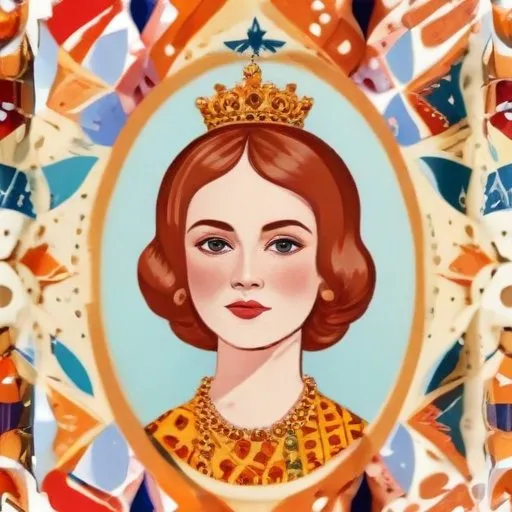
The youngest daughter of Grand Duke Michael Nikolaevich of Russia, she was a fashion icon and socialite in the late 19th and early 20th centuries, known for her beauty and lavish lifestyle. She married into the German nobility and lived a life of luxury until her death in 1922.
Grand Duchess Anastasia Mikhailovna of Russia was a member of the esteemed House of Romanov, known for her unconventional lifestyle, strong will, and royal scandals that made headlines. She was a granddaughter of Emperor Nicholas I of Russia and the only daughter of Grand Duke Michael Nicolaievich of Russia, but it was her independent spirit and unapologetic approach to life that truly defined her legacy.
Anastasia was born on July 28, 1860, in St. Petersburg, Russia. She spent her early years in the Caucasus region, where her family resided between 1862 and 1878. In 1879, she married Friedrich Franz III, Grand Duke of Mecklenburg-Schwerin, with whom she had three children: Duchess Alexandrine, Frederick Francis IV, and Duchess Cecilie.
However, Anastasia's marriage was not without controversy. Her husband suffered from ill health, and the couple spent most of their time living abroad. As a result, Anastasia developed a close relationship with her personal secretary, with whom she had a child in 1902, sparking a royal scandal that would tarnish her reputation. Despite the backlash, Anastasia remained unapologetic and continued to live life on her own terms.
After the death of her husband in 1897, Anastasia's visits to Schwerin became sparse, and she spent most of her time in the South of France and later in neutral Switzerland during World War I. She died on March 11, 1922, following a stroke, leaving behind a legacy that would be remembered for generations to come.
Through her children, Anastasia's legacy extends to the royal families of Denmark, Hanover, and Prussia, cementing her place in the annals of European royal history.
While Anastasia may not have left behind a trove of quotes, her life's work speaks volumes about the importance of independence, self-expression, and living life on one's own terms. As a royal who refused to be bound by convention, Anastasia embodied the spirit of a true trailblazer.
In a world where royal protocol often takes precedence over personal freedom, Anastasia's story serves as a testament to the power of individuality and the importance of staying true to oneself, even in the face of adversity.
Grand Duchess Anastasia Mikhailovna of Russia may have lived a life marked by controversy, but it is her unwavering commitment to herself that will continue to inspire generations to come.
Born in 1868
The last emperor of Russia, ruling from 1894 to 1917, known for his poor leadership and decisions that led to the downfall of the Romanov dynasty and the rise of communism.
Born in 1845
The Russian monarch who ruled from 1881 to 1894, known for his conservative and nationalistic policies, as well as his efforts to reform the Russian Empire's government and economy.
Born in 1759
The wife of Paul I of Russia, a powerful empress who played a significant role in shaping the country's politics and culture during the late 18th century. She was a patron of the arts and a strong advocate for education and women's rights.
