


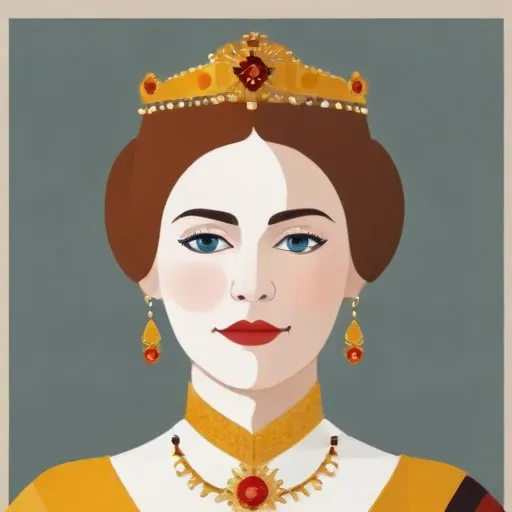
The wife of Paul I of Russia, a powerful empress who played a significant role in shaping the country's politics and culture during the late 18th century. She was a patron of the arts and a strong advocate for education and women's rights.
Maria Feodorovna, the wife of Emperor Paul I of Russia, is renowned for her tireless efforts in establishing and managing numerous charitable institutions, earning her the esteemed title of "Angel of Charity." As the founder of the Office of the Institutions of Empress Maria, she dedicated her life to improving the welfare of the Russian people, leaving an indelible mark on the country's social and cultural fabric.
Born as Duchess Sophie Dorothea of Württemberg on October 25, 1759, Maria Feodorovna was part of a junior branch of the House of Württemberg. She received an excellent education in Montbliard, which would later serve her well in her role as Empress. Following the death of Paul I's first wife, King Frederick II of Prussia and Empress Catherine II of Russia chose Sophie Dorothea as the ideal candidate to become Paul's second wife. She converted to the Russian Orthodox Church in 1776, adopting the name Maria Feodorovna.
Despite her efforts to build a strong relationship with her husband, Maria Feodorovna was largely excluded from political influence during her mother-in-law's reign (1762-1796). She and Paul were forced to live in isolation at Gatchina Palace, where they had many children together. The tension between mother and son only grew, and Maria Feodorovna's initial affection from Catherine II began to wane.
Upon Paul I's ascension to the throne in 1796, Maria Feodorovna finally had the opportunity to make a tangible impact. She exercised considerable influence during her husband's four-year reign, using her position to establish and support various charitable institutions. After Paul's assassination in 1801, Maria Feodorovna went on to found and manage numerous establishments, including orphanages, hospitals, and educational institutions.
Maria Feodorovna's dedication to charity and philanthropy earned her a revered place in Russian history. She instituted the precedence whereby the Empress dowager outranked the reigning monarch's wife, a system unique to the Russian court. Her remodeling of the palaces of Gatchina and Pavlovsk showcased her refined taste and cultural sophistication. Through her tireless efforts, Maria Feodorovna left an indelible mark on Russia's social and cultural landscape.
Maria Feodorovna's life and reign were marked by significant historical events, including the reign of Catherine II, the Napoleonic Wars, and the rise of the Russian Empire. Her philanthropic efforts and cultural contributions have had a lasting impact on Russian society, earning her a revered place in the country's history. Through her remarkable life and achievements, Maria Feodorovna has left an enduring legacy as one of Russia's most beloved and respected Empresses.
Born in 1729
Empress of Russia from 1762 to 1796, she transformed her country into a major European power, modernizing its culture, politics, and economy through numerous reforms and conquests.
Born in 1818
Liberalizing reforms and abolishing serfdom in Russia, earning the nickname "Liberator."
Born in 1868
The last emperor of Russia, ruling from 1894 to 1917, known for his poor leadership and decisions that led to the downfall of the Romanov dynasty and the rise of communism.
Born in 1845
The Russian monarch who ruled from 1881 to 1894, known for his conservative and nationalistic policies, as well as his efforts to reform the Russian Empire's government and economy.
Born in 1875
Queen of Romania from 1914 to 1927, known for her diplomatic efforts during World War I and her role in Romania's gaining of Transylvania.
Born in 1851
The queen consort of Greece from 1867 to 1913, known for her strong personality and efforts to promote Greek culture and education. She was also a skilled artist and philanthropist.
