


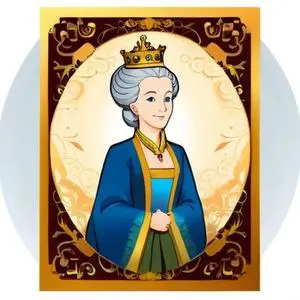
Empress of Russia from 1762 to 1796, she transformed her country into a major European power, modernizing its culture, politics, and economy through numerous reforms and conquests.
Catherine the Great, born Princess Sophie Augusta Frederica von Anhalt-Zerbst, is renowned for transforming Russia into a dominant European power, rivaling the likes of Western European nations. Her 34-year reign, from 1762 to 1796, was marked by a cultural and scientific renaissance, earning her a place in history as one of the most influential women of the 18th century.
Born on May 2, 1729, in Prussia (now part of modern-day Germany), Catherine was the daughter of a minor German prince. She married Peter III, the grandson of Peter the Great, and arrived in Russia in 1744. Catherine quickly adopted the Orthodox faith and immersed herself in Russian culture, eventually winning over the hearts of the nobility and the people.
In 1762, Catherine orchestrated a coup against her husband, Peter III, and seized the throne for herself. With the support of her noble favorites, such as Count Grigory Orlov, she solidified her position as the Empress of Russia.
Catherine was a staunch admirer of the Enlightenment and its ideals. She surrounds herself with intellectuals and artists, inviting prominent thinkers like Voltaire and Diderot to her court. She established the Smolny Institute for Noble Maidens, the first women's educational institution in Russia, and encouraged the development of arts, literature, and sciences.
Under her patronage, Russia experienced a cultural explosion, with the founding of numerous cities, universities, and theaters. The capital city of St. Petersburg was transformed into a hub of artistic and intellectual activity, earning the nickname "the Venice of the North."
Catherine's reign was marked by a series of military victories and strategic alliances, expanding Russia's borders and establishing its status as a major European power. She annexed the Crimean Khanate, colonized the territories of New Russia, and partitioned the Polish-Lithuanian Commonwealth, gaining the largest share for Russia.
In the east, Russian settlers began to colonize Alaska, establishing the colony of Russian America. Catherine's military campaigns were led by successful generals like Alexander Suvorov and Pyotr Rumyantsev, and admirals like Samuel Greig and Fyodor Ushakov.
Catherine's personal life was marked by a series of romantic relationships with her noble favorites, including Count Grigory Orlov and Grigory Potemkin. These relationships often influenced her political decisions and policies, but also inspired her to promote the interests of Russia.
Catherine was known for her intelligence, determination, and strong will, earning her the respect and admiration of her people. Despite her flaws and controversies, she remains one of the most beloved and celebrated rulers in Russian history.
Catherine the Great left an indelible mark on Russian history, transforming the country into a major European power. Her cultural and scientific reforms, military conquests, and enlightened policies shaped the course of Russian development, earning her a place among the greatest rulers of all time.
Today, Catherine's legacy continues to inspire and influence Russian society, with her name synonymous with grandeur, wisdom, and vision. Her impact on world history serves as a testament to the power of vision, determination, and strong leadership.
"I shall be an autocrat, that's my trade; and the good of the Russians is my chief and dearest concern."
"I am not afraid of death, but I would rather die of other causes than of old age."
"A great wind is blowing, and that gives you either imagination or a headache."
Catherine the Great's legacy continues to inspire and awe, a testament to the power of vision, determination, and strong leadership.
Born in 1672
Reformed Russia's government, military, and culture, transforming it into a major European power. Known for modernizing and westernizing the country through numerous reforms and founding St. Petersburg.
Born in 1638
Portuguese princess who married King Charles II of England, bringing Bombay and Tangier to the British Empire as part of her dowry. She also popularized tea drinking in Britain.
Born in 1739
A Russian military leader and statesman who oversaw the annexation of Crimea and was a key advisor to Catherine the Great, known for his military conquests and lavish fake villages.
Born in 1729
A renowned military strategist and tactician, credited with never losing a battle, and reforming the Russian army with innovative tactics and training methods.
Born in 1711
A Russian polymath who made significant contributions to various fields, including the discovery of the atmosphere of Venus and the development of a comprehensive theory of the Earth's origin. They are also credited with founding Moscow State University.
