


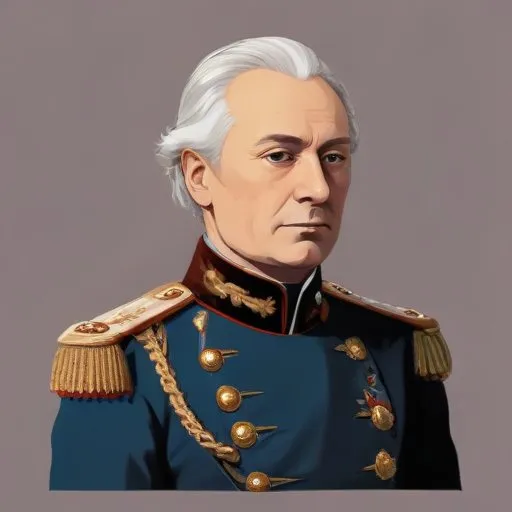
A renowned military strategist and tactician, credited with never losing a battle, and reforming the Russian army with innovative tactics and training methods.
Alexander Suvorov is renowned as one of the most exceptional military minds in history, with an unparalleled record of victories that earned him the adoration of his contemporaries and the respect of his enemies. Born on November 13, 1729, in Moscow, Russia, Suvorov's illustrious career spanned over four decades, leaving an indelible mark on the Russian Empire and the world of military strategy.
Suvorov's fascination with military history began at a young age, and he joined the Imperial Russian Army at just 17 years old. His innate talent and dedication earned him rapid promotion to colonel in 1762, following his impressive performances during the Seven Years War. Suvorov's innovative approach to warfare, rooted in his deep understanding of classical military theory, allowed him to adapt and improvise on the battlefield, often turning the tide of battle in favor of the Russian Empire.
In the late 1790s, Suvorov's exceptional leadership skills and strategic brilliance were called upon to lead the Austro-Russian army against the forces of Napoleon Bonaparte. During this period, he secured a string of victories, including the Battle of the Trebbia (1799), and succeeded in capturing Milan and Turin, nearly erasing Napoleon's Italian conquests.
Suvorov was born into a noble family and received a classical education, which instilled in him a deep appreciation for military history and theory.
His early successes during the Seven Years War and the War of the Bar Confederation earned him rapid promotion and recognition within the Russian Empire.
Despite periods of ill-favor and disagreement with Emperor Paul I, Suvorov remained a revered figure in Russian society until his passing on May 6, 1800. His legacy as a brilliant general and military theorist continues to inspire military strategists and historians around the world.
Suvorov's impact on modern warfare cannot be overstated. His emphasis on speed, adaptability, and initiative on the battlefield has influenced military doctrine for centuries, shaping the course of conflicts and inspiring generations of military leaders.
Alexander Suvorov's remarkable career and achievements are a testament to the power of innovation, strategic thinking, and unwavering dedication. As one of the greatest military minds in history, his legacy continues to captivate and inspire, serving as a beacon of excellence for military leaders and historians alike.
"The most brilliant general in Russia, if not in all of Europe."
Born in 1729
Empress of Russia from 1762 to 1796, she transformed her country into a major European power, modernizing its culture, politics, and economy through numerous reforms and conquests.
Born in 1739
A Russian military leader and statesman who oversaw the annexation of Crimea and was a key advisor to Catherine the Great, known for his military conquests and lavish fake villages.
Born in 1745
A renowned Russian field marshal who led the country to victory against Napoleon's army in the Patriotic War of 1812, and is celebrated for his strategic genius and patriotism.
Born in 1769
A French military leader who rose to prominence during the French Revolution and became Emperor of France, known for his military conquests and reorganization of Europe. He is also famous for his Napoleonic Code, which remains a foundation of modern law.
Born in 1878
The Soviet Union's ruthless leader who ruled with an iron fist, implementing policies that led to widespread famine and purges, while also playing a crucial role in defeating Nazi Germany in World War II.
Born in 1319
King of Aragon from 1336 to 1387, known for his military campaigns and territorial expansions, as well as his patronage of the arts and architecture.
Born in 1550
The pope who condemned Galileo's heliocentric theory and established the Immaculate Conception as Catholic dogma, shaping the Church's stance on science and theology.
Born in 1397
The 15th-century pope who played a crucial role in shaping the Renaissance by commissioning translations of ancient Greek works, promoting classical learning, and fostering cultural revival. He's also known for issuing the papal bull "Dum Diversas," which sanctioned the colonization and enslavement of non-Christians.
