


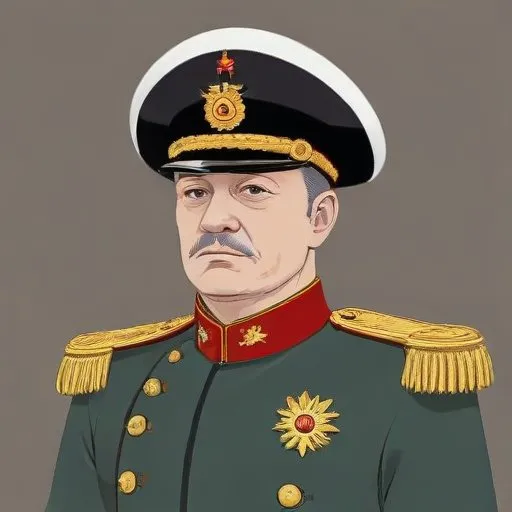
A Russian military leader and statesman who oversaw the annexation of Crimea and was a key advisor to Catherine the Great, known for his military conquests and lavish fake villages.
Grigory Potemkin, the illustrious Russian military leader, statesman, and nobleman, is perhaps best known for his enduring romance with Catherine the Great and his instrumental role in shaping the fate of the Russian Empire. As her favorite, and possibly her consort, Potemkin left an indelible mark on Russian history, earning himself the titles of Prince of the Holy Roman Empire and Prince of the Russian Empire.
Born on October 11, 1739, into a family of middle-income noble landowners, Potemkin's thirst for adventure and ambition drove him to seek out opportunities in the highest echelons of Russian society. His chance encounter with Catherine the Great in 1762 proved to be the catalyst for his meteoric rise, as he played a pivotal role in her successful coup.
In the Russo-Turkish War of 1768-1774, Potemkin's military prowess earned him recognition and acclaim, cementing his position as Catherine's trusted advisor and confidant. As their passion cooled, Potemkin remained her lifelong friend and favored statesman, wielding considerable influence over the Russian Empire.
Potemkin's military campaigns were marked by a string of successes, including the peaceful annexation of the Crimea in 1783 and the triumphant conclusion of the second Russo-Turkish War in 1792. His strategic genius and visionary leadership enabled Russia to expand its borders, bolster its military might, and establish itself as a dominant power.
In 1775, Potemkin became the governor-general of Russia's new southern provinces, where he worked tirelessly to colonize the wild steppes and establish a string of thriving cities, including Kherson, Nikolayev, Sevastopol, and Yekaterinoslav. His tenure was marked by controversy, however, as he dealt firmly with the Cossacks who inhabited the region.
Potemkin's reputation for grandeur and extravagance has given rise to the legend of the Potemkin village, a supposedly mythical ruse involving the construction of painted façades to mimic real villages, complete with happy, well-fed people, for visiting officials to admire. While the veracity of this claim remains disputed, it speaks to Potemkin's flamboyant personality and penchant for the dramatic.
Potemkin's private life was marked by a love of women, gambling, and material wealth. He was known for his extravagant tastes, which extended to his architectural endeavors, including the construction of the breathtaking Tauride Palace in Saint Petersburg.
As a visionary statesman, military commander, and patron of the arts, Grigory Potemkin left an enduring legacy that continues to shape Russian history and culture. His achievements serve as a testament to his boundless energy, unwavering ambition, and unshakeable dedication to the Russian Empire.
Grigory Potemkin's remarkable life and accomplishments continue to captivate historians and enthusiasts alike, serving as a shining example of the power of vision, determination, and sheer force of personality.
Born in 1729
Empress of Russia from 1762 to 1796, she transformed her country into a major European power, modernizing its culture, politics, and economy through numerous reforms and conquests.
Born in 1729
A renowned military strategist and tactician, credited with never losing a battle, and reforming the Russian army with innovative tactics and training methods.
Born in 1745
A renowned Russian field marshal who led the country to victory against Napoleon's army in the Patriotic War of 1812, and is celebrated for his strategic genius and patriotism.
Born in 1769
A French military leader who rose to prominence during the French Revolution and became Emperor of France, known for his military conquests and reorganization of Europe. He is also famous for his Napoleonic Code, which remains a foundation of modern law.
Born in 1878
The Soviet Union's ruthless leader who ruled with an iron fist, implementing policies that led to widespread famine and purges, while also playing a crucial role in defeating Nazi Germany in World War II.
Born in 1870
Founder of the world's first socialist state, leading the Bolshevik Revolution and establishing the Soviet Union, known for his radical Marxist ideology and authoritarian rule.
Born in 1879
Founded the Red Army and played a crucial role in the Russian Revolution, shaping the course of modern communism. A key figure in 20th-century politics and ideology.
Born in 1799
Russia's literary icon penned timeless tales of love, drama, and social commentary, leaving an indelible mark on the country's cultural heritage.
