


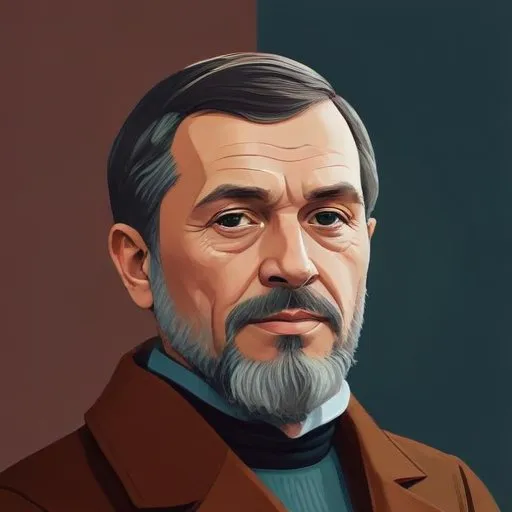
Russian-Estonian astronomer who calculated the orbit of asteroid 1484 Postrema and discovered several minor planets, making significant contributions to our understanding of the solar system.
Grigori Kuzmin, the renowned Estonian astronomer, is best known for his groundbreaking contributions to the field of stellar dynamics, a branch of astronomy that deals with the movement and behavior of stars within galaxies.
Kuzmin was born on April 8, 1917, in Viipuri, part of the Grand Duchy of Finland, to a Russian family. In 1924, his family moved to Tallinn, Estonia, where he attended school and developed a strong affinity for the Estonian language, which would later become his primary language.
Kuzmin's academic excellence earned him a cum laude graduation from the University of Tartu in 1940. This marked the beginning of his illustrious career in astronomy, which would take him to the forefront of stellar dynamics research.
Kuzmin's work focused on the theoretical aspects of stellar dynamics, particularly the study of the orbits of stars within galaxies. His research led to significant advancements in the understanding of galaxy structures and the behavior of star clusters. His contributions have had a lasting impact on the field, shaping the course of future research.
Kuzmin's work has inspired generations of astronomers, shaping the course of research in stellar dynamics and galaxy evolution. His contributions have also influenced the development of modern astronomic instruments and techniques.
Kuzmin's outstanding contributions to astronomy earned him several prestigious awards and honors, including the Estonian SSR State Prize in Science (1975) and the Tartu University Medal (1985).
Grigori Kuzmin's pioneering work in stellar dynamics has left an indelible mark on the field of astronomy. His legacy continues to inspire new generations of astronomers, ensuring that his contributions remain relevant and impactful in the pursuit of understanding the universe.
Kuzmin's remarkable life and achievements serve as a testament to his dedication to the pursuit of knowledge, leaving behind a rich legacy that continues to shape the course of astronomical research.
Grigori Kuzmin's remarkable life and achievements continue to inspire and educate astronomers and enthusiasts alike, cementing his place as one of the most influential astronomers of the 20th century.
Born in 1916
A Soviet physicist who made groundbreaking contributions to the theory of superconductivity and superfluidity, earning him the Nobel Prize in Physics in 2003.
Born in 1921
A Soviet physicist and dissident who advocated for human rights and nuclear disarmament, earning a Nobel Peace Prize in 1975. He's known for his courageous stance against the Soviet regime, promoting peace and democracy.
98 Years Old
A pioneering cosmonaut who flew on three Soyuz missions, including the first-ever space docking, and later became a high-ranking military officer. He played a crucial role in the development of Soviet space exploration.
