


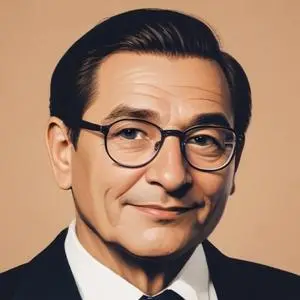
A Soviet physicist who made groundbreaking contributions to the theory of superconductivity and superfluidity, earning him the Nobel Prize in Physics in 2003.
Vitaly Lazarevich Ginzburg, a Russian physicist of immense renown, was awarded the Nobel Prize in Physics in 2003 for his pioneering contributions to the theory of superconductors and superfluids. Alongside Alexei Abrikosov and Anthony Leggett, Ginzburg's groundbreaking work transformed our understanding of the mysterious realm of superconductivity.
Born on October 4, 1916, in Moscow, Russia, Ginzburg was the son of an engineer and a doctor. He graduated from the Physics Faculty of Moscow State University in 1938 and went on to defend his Kandidat Nauk dissertation in 1940 and his Doktor Nauk thesis in 1942.
In 1950, Ginzburg, in collaboration with Lev Landau, developed the Ginzburg-Landau theory, a partially phenomenological theory of superconductivity. This groundbreaking theory provided a fundamental understanding of superconductors, enabling the development of applications in fields such as energy transmission and medical imaging.
Ginzburg's illustrious career was marked by numerous achievements, including his work on the theory of electromagnetic wave propagation in plasmas and his contribution to the understanding of the origin of cosmic radiation. He was a member of the Russian Academy of Sciences and headed the Department of Theoretical Physics of the Lebedev Physical Institute of the Russian Academy of Sciences (FIAN).
A vocal critic of clerical influence in Russian society, Ginzburg became an outspoken atheist later in life. He was also instrumental in debunking the flawed theories of Trofim Lysenko, an anti-Mendelian agronomist, paving the way for the return of modern genetic science to the USSR.
Ginzburg married Olga Zamsha in 1937 and later married Nina Yershova in 1946. His legacy extends beyond the realm of physics, inspiring future generations of scientists and thinkers to question, challenge, and innovate.
Vitaly Ginzburg's remarkable journey is a testament to the power of human curiosity and perseverance. As we reflect on his life and achievements, we are reminded of the profound impact that pioneering scientists can have on our understanding of the world and our place within it.
Born in 1921
A Soviet physicist and dissident who advocated for human rights and nuclear disarmament, earning a Nobel Peace Prize in 1975. He's known for his courageous stance against the Soviet regime, promoting peace and democracy.
Born in 1908
A renowned physicist and academic who made groundbreaking contributions to our understanding of quantum mechanics, superfluidity, and particle physics, earning a Nobel Prize in Physics in 1962.
Born in 1894
A Soviet physicist who discovered superfluidity and made significant contributions to the study of low-temperature physics, earning him a Nobel Prize in Physics in 1978.
Born in 1895
A Soviet physicist who developed the concept of the "tokamak," a device used to confine and study plasmas at extremely high temperatures, leading to advancements in nuclear fusion research.
Born in 1922
Russian physicist and academic who developed masers and lasers, pioneering the field of quantum electronics. He was awarded the Nobel Prize in Physics in 1964 for his work.
Born in 1925
A Japanese physicist and academic who discovered the phenomenon of electron tunneling, earning him a Nobel Prize in Physics in 1973. His work led to the development of semiconductors and modern electronics.
97 Years Old
A Nobel Prize-winning physicist who pioneered the field of superconductivity, making groundbreaking discoveries that transformed our understanding of materials and their properties.
