


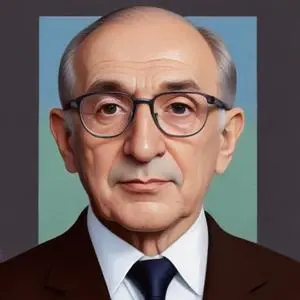
A renowned physicist and academic who made groundbreaking contributions to our understanding of quantum mechanics, superfluidity, and particle physics, earning a Nobel Prize in Physics in 1962.
Lev Landau, a Soviet physicist, left an indelible mark on the world of theoretical physics. He is renowned for his groundbreaking contributions to various areas, including quantum mechanics, superfluidity, and superconductivity, earning him the 1962 Nobel Prize in Physics.
Born on January 22, 1908, in Baku, Russian Empire (now Azerbaijan), to Jewish parents, Landau was a child prodigy. He learned differential calculus at 12 and integral calculus at 13. After graduating from gymnasium at 13, he attended the Baku Economical Technical School for a year before entering Baku State University at 14, where he studied physics, mathematics, and chemistry.
Landau's research spanned multiple areas, including:
Independent codiscovery of the density matrix method in quantum mechanics with John von Neumann
Development of the quantum mechanical theory of diamagnetism
Theory of superfluidity, for which he received the Nobel Prize
Theory of second-order phase transitions
Invention of the order parameter technique
Ginzburg-Landau theory of superconductivity
Theory of Fermi liquids
Landau damping in plasma physics
Landau pole in quantum electrodynamics
Two-component theory of neutrinos
Landaus equations for S-matrix singularities
Landau's work has had a significant impact on modern society, from the development of superconducting materials to the understanding of quantum systems. His theories have also inspired new areas of research, such as superfluidity and quantum computing.
In popular culture, Landau's work has been referenced in various media, including science fiction novels and documentaries.
Landau's contributions were recognized with numerous awards and honors, including:
1962 Nobel Prize in Physics
Stalin Prize (1946 and 1953)
Lenin Prize (1958)
Hero of Socialist Labor (1958)
Landau was known for his simplicity, humility, and kindness. Despite his immense contributions to physics, he remained humble and continued to work tirelessly until his death on April 1, 1968.
Today, Landau's legacy continues to inspire new generations of physicists and researchers, cementing his place as one of the most influential scientists of the 20th century.
Born in 1885
A pioneer in quantum mechanics, he introduced the concept of wave-particle duality, revolutionizing our understanding of atomic structure. His philosophical approach to science also explored the nature of reality and human understanding.
Born in 1879
A brilliant physicist who developed the theory of relativity and is considered one of the most influential scientists of the 20th century, known for his groundbreaking work in physics and mathematics.
Born in 1901
A pioneer in quantum mechanics, he formulated the uncertainty principle, which revolutionized our understanding of the atomic world. His groundbreaking work reshaped modern physics.
Born in 1902
A brilliant mind who formulated the Dirac equation, a fundamental concept in quantum mechanics, and predicted the existence of antimatter. His work revolutionized our understanding of the universe.
Born in 1918
A brilliant physicist and engineer who pioneered quantum mechanics and famously explained complex concepts in simple terms, making science accessible to all.
97 Years Old
A pioneer in particle physics, discovering subatomic particles like quarks and gluons, and developing the theory of quantum chromodynamics.
Born in 1921
A Soviet physicist and dissident who advocated for human rights and nuclear disarmament, earning a Nobel Peace Prize in 1975. He's known for his courageous stance against the Soviet regime, promoting peace and democracy.
