


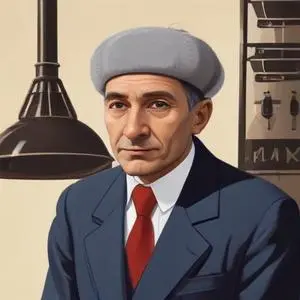
A Soviet physicist who discovered superfluidity and made significant contributions to the study of low-temperature physics, earning him a Nobel Prize in Physics in 1978.
Pyotr Kapitsa, a Nobel laureate and renowned Soviet physicist, is widely recognized for his groundbreaking research in low-temperature physics, which led to the discovery of superfluidity. His pioneering work in the field of cryogenics has had a profound impact on modern science, earning him a permanent place in the annals of physics.
Born on July 9, 1894, in Kronstadt, Russian Empire, Pyotr Kapitsa was the son of a military engineer and a noble Polish mother. His family spoke both Russian and Romanian, which later influenced his eclectic approach to science.
Kapitsa's education was interrupted by World War I, during which he served as an ambulance driver for two years on the Polish front. After the war, he graduated from the Petrograd Polytechnical Institute in 1918. Tragedy struck when his wife and two children died in the flu epidemic of 1918-1919, leading him to seek solace in his research.
Kapitsa's big break came when he moved to Britain, where he worked with the esteemed Ernest Rutherford at the Cavendish Laboratory, University of Cambridge. During his decade-long stint, he founded the influential Kapitza Club, a think tank that brought together prominent scientists to discuss cutting-edge ideas.
At Cambridge, Kapitsa developed techniques for creating ultra-strong magnetic fields, paving the way for his later discoveries. In 1928, he discovered the linear relation between resistivity and magnetic field strength in various metals under strong magnetic fields, a finding that would shape his future research.
In 1934, Kapitsa returned to Russia to visit his parents, only to find himself unable to return to Cambridge due to Soviet restrictions. Undeterred, he redirected his research focus to low-temperature phenomena, criticizing existing methods and developing new approaches.
This period marked a significant turning point in Kapitsa's career, as he went on to make several landmark discoveries, including the observation of superfluidity in helium-4 at extremely low temperatures. This breakthrough earned him the Nobel Prize in Physics in 1978, along with Arno Penzias and Robert Wilson.
Kapitsa's contributions to physics have had far-reaching consequences, influencing fields as diverse as cryogenics, materials science, and quantum mechanics. His work has inspired generations of scientists, including notable physicists like Lev Landau and Andrei Sakharov.
Apart from his scientific achievements, Kapitsa was known for his strong personality, his love of poetry, and his passion for skiing. He once quipped, "The ability to cope with the unexpected is the most important quality of a physicist."
Pyotr Kapitsa's remarkable journey, marked by both triumph and tragedy, serves as a testament to the power of human curiosity and perseverance. His groundbreaking research continues to inspire scientists today, leaving an indelible mark on the world of physics.
Born in 1908
A renowned physicist and academic who made groundbreaking contributions to our understanding of quantum mechanics, superfluidity, and particle physics, earning a Nobel Prize in Physics in 1962.
Born in 1921
A Soviet physicist and dissident who advocated for human rights and nuclear disarmament, earning a Nobel Peace Prize in 1975. He's known for his courageous stance against the Soviet regime, promoting peace and democracy.
Born in 1896
A Russian physicist and chemist who made groundbreaking contributions to the understanding of chemical reactions, particularly in the field of combustion, and was awarded the Nobel Prize in Chemistry in 1956.
Born in 1895
A Soviet physicist who developed the concept of the "tokamak," a device used to confine and study plasmas at extremely high temperatures, leading to advancements in nuclear fusion research.
Born in 1908
A Soviet physicist who discovered and explained the phenomenon of Cherenkov radiation, a crucial finding in particle physics. This discovery led to the development of new methods for detecting and studying subatomic particles.
Born in 1898
A pioneer in nuclear physics, known for conceiving the idea of a nuclear chain reaction and patenting the concept of a nuclear reactor. He also played a key role in persuading Einstein to warn Roosevelt about the possibility of Germany developing an atomic bomb.
Born in 1901
A pioneer in nuclear physics, known for leading the team that developed the first nuclear reactor and playing a crucial role in the development of the atomic bomb.
Born in 1918
A brilliant physicist and engineer who pioneered quantum mechanics and famously explained complex concepts in simple terms, making science accessible to all.
