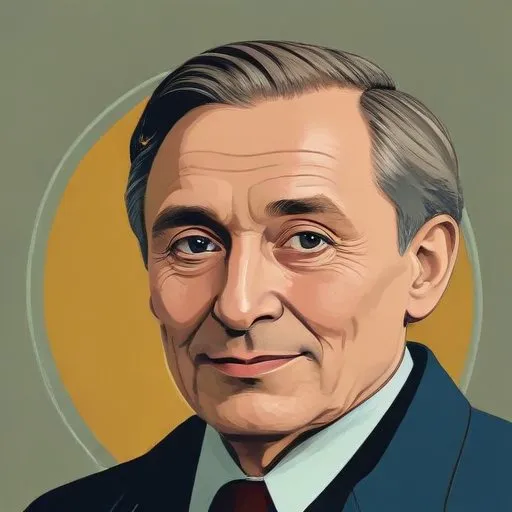
Ilya Frank: The Soviet Physicist Who Illuminated the Secrets of Cherenkov Radiation
A Pioneer in Nuclear Physics and Nobel Laureate
Ilya Mikhailovich Frank was a renowned Soviet physicist who received the 1958 Nobel Prize in Physics for his groundbreaking work in explaining the phenomenon of Cherenkov radiation. This pioneering discovery, made jointly with Pavel Alekseyevich Cherenkov and Igor Y. Tamm, revolutionized the field of nuclear physics and shed light on the mysteries of high-energy particles.
Early Life and Education
Born on October 23, 1908, in St. Petersburg, Russia, Ilya Frank came from a family of intellectuals. His father, Mikhail Lyudvigovich Frank, was a talented mathematician, while his mother, Yelizaveta Mikhailovna Gratsianova, was a Russian Orthodox physician. His uncle, Semyon Frank, was a notable Russian philosopher who was later expelled from the USSR in 1922.
Frank's academic journey began at Moscow State University, where he studied mathematics and theoretical physics. Under the guidance of his mentor,
Sergey Ivanovich Vavilov, he worked in the laboratory and co-authored his first publication on luminescence in 1930. This early research laid the foundation for his doctoral dissertation in 1935.
Career and Breakthroughs
In 1934, Frank joined the Institute of Physics and Mathematics of the USSR Academy of Sciences, where he delved into nuclear physics, a new and exciting field at the time. It was during this period that he became fascinated with the work of Pavel Cherenkov, who had discovered a peculiar phenomenon where charged particles emitted light when traveling at speeds greater than the phase velocity of light in a medium. Frank's contributions to understanding this phenomenon, now known as Cherenkov radiation, earned him the Nobel Prize in 1958.
Awards and Honors
Ilya Frank's groundbreaking work was recognized with numerous awards, including:
- 1958 Nobel Prize in Physics
- Stalin Prize (1946 and 1953)
- USSR State Prize (1971)
Legacy and Impact
Frank's work on Cherenkov radiation has had a profound impact on modern physics, paving the way for significant advancements in particle physics, nuclear reactors, and medical imaging. His discoveries have also inspired new generations of physicists and researchers, cementing his place as one of the most influential scientists of the 20th century.
Personal Milestones and Trivia
Ilya Frank's life was marked by both personal and professional milestones, including:
- Brother, Gleb Mikhailovich Frank, a prominent biophysicist
- Uncle, Semyon Frank, a noted Russian philosopher
- Long-term collaboration with Sergey Ivanovich Vavilov, his mentor
Frank's remarkable journey, marked by groundbreaking discoveries and prestigious awards, is a testament to his dedication to the pursuit of knowledge and his unwavering passion for physics.
FAQ
What is Ilya Franks most notable scientific contribution?
Ilya Frank is best known for his work on the theory of Cherenkov radiation, which is a fundamental concept in particle physics.
What did Ilya Frank win the Nobel Prize in Physics for?
Ilya Frank was awarded the Nobel Prize in Physics in 1958, along with Pavel Cherenkov and Igor Tamm, for their discovery of Cherenkov radiation.
Where did Ilya Frank conduct his research?
Ilya Frank conducted his research at the Lebedev Physical Institute in Moscow, where he worked with other prominent physicists of the time.
What are Ilya Franks notable publications?
Ilya Frank published numerous papers on theoretical physics, including his work on Cherenkov radiation and its applications in particle physics.
How did Ilya Franks work on Cherenkov radiation impact the field of physics?
Ilya Franks work on Cherenkov radiation led to a deeper understanding of the behavior of subatomic particles and paved the way for the development of new detection methods in particle physics.