


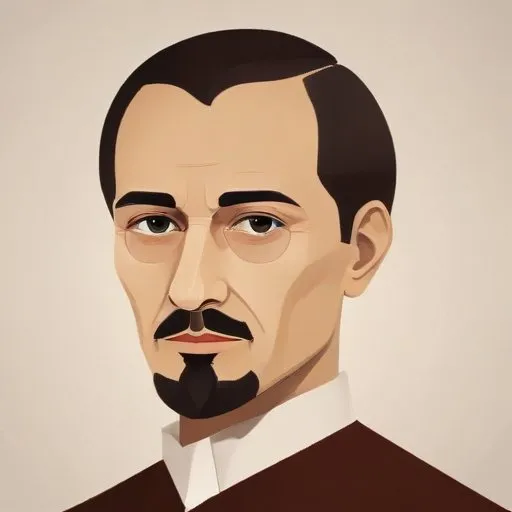
A Russian mathematician and academic who made groundbreaking contributions to the field of mathematics, particularly in the area of ergodic theory, and was awarded the Fields Medal in 1978.
Grigory Margulis is a Russian-American mathematician renowned for his groundbreaking work on lattices in Lie groups and his pioneering introduction of methods from ergodic theory into diophantine approximation. His contributions to the field have earned him some of the most prestigious awards in mathematics, including the Fields Medal, Wolf Prize, and Abel Prize.
Born on February 24, 1946, in Moscow, Soviet Union, to a Russian family of Lithuanian Jewish descent, Margulis demonstrated an exceptional aptitude for mathematics from a young age. At the tender age of 16, he won the silver medal at the International Mathematical Olympiad in 1962, setting the stage for his future accomplishments.
Margulis received his Ph.D. in 1970 from Moscow State University, where he began his research in ergodic theory under the supervision of Yakov Sinai. This marked the beginning of his remarkable journey in mathematics.
Margulis's work with David Kazhdan produced the Kazhdan-Margulis theorem, a fundamental result on discrete groups that laid the foundation for his future research. His superrigidity theorem (1975) clarified an area of classical conjectures about the characterization of arithmetic groups amongst lattices in Lie groups.
In 1978, Margulis was awarded the Fields Medal, a prestigious honor that recognized his outstanding contributions to mathematics. Although he was not permitted to travel to Helsinki to accept the award in person due to alleged anti-Semitism against Jewish mathematicians in the Soviet Union, this Incident did not deter him from pursuing his passion for mathematics.
In 1991, Margulis joined the faculty of Yale University, where he currently holds the position of Erastus L. De Forest Professor of Mathematics. He was elected a member of the U.S. National Academy of Sciences in 2001 and became a fellow of the American Mathematical Society in 2012.
In 2005, Margulis received the Wolf Prize in Mathematics for his significant contributions to the theory of lattices and applications to ergodic theory, representation theory, and number theory. This recognition was followed by the Abel Prize in 2020, making him the fifth mathematician to receive all three prizes.
Margulis's work has had a profound impact on the development of ergodic theory, diophantine approximation, and number theory. His introduction of methods from ergodic theory into diophantine approximation has opened up new avenues for research in these areas.
Through his contributions, Margulis has inspired generations of mathematicians, shaping the landscape of modern mathematics and pushing the boundaries of human understanding.
Grigory Margulis's remarkable journey is a testament to his perseverance, dedication, and passion for mathematics. His legacy will continue to inspire and influence mathematicians for generations to come.
As a mathematician, teacher, and mentor, Margulis has made an indelible mark on the world of mathematics, leaving behind a rich heritage of ideas, theorems, and insights that will forever change the way we approach the subject.
80 Years Old
A renowned mathematician and academic, he made significant contributions to representation theory, number theory, and algebraic geometry, earning numerous awards for his groundbreaking work.
97 Years Old
A renowned mathematician and academic who made groundbreaking contributions to topology, geometry, and theoretical physics, earning him numerous accolades, including the Fields Medal and Abel Prize.
77 Years Old
A renowned mathematician and academic who made groundbreaking contributions to differential geometry, topology, and geometric analysis, earning him a Fields Medal and numerous other accolades.
73 Years Old
Proved Fermat's Last Theorem, a problem that went unsolved for over 350 years, and made significant contributions to number theory. His work has far-reaching implications for mathematics and cryptography.
99 Years Old
A renowned mathematician and academic, he is most known for his groundbreaking work in algebraic geometry and number theory, earning him a Fields Medal in 1954.
Born in 1917
A renowned mathematician who made significant contributions to number theory, particularly in the development of the Selberg trace formula, and was awarded the Fields Medal and the Abel Prize.
