


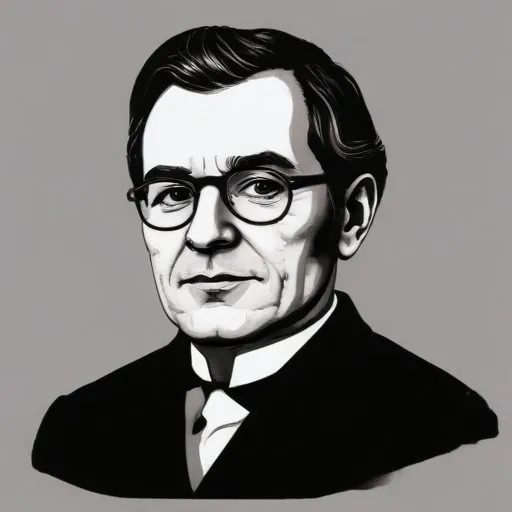
Estonian mathematician and academic who made significant contributions to differential geometry and topology, and wrote popular science books to make mathematics accessible to a broader audience.
Gunnar Kangro, a renowned Estonian mathematician, is best known for his groundbreaking work in summation theory, making significant contributions to the field of mathematics. His innovative approach to convergence theory has had a lasting impact on the way mathematicians approach complex power series.
Kangro was born on November 21, 1913, in Tartu, Estonia, to a construction engineer and a building contractor. He graduated from Tartu Secondary Science School in 1931 and went on to study mathematics at the University of Tartu. After completing his undergraduate degree in 1935, he served in the Estonian Defence Forces before being appointed as a junior assistant in the Laboratory of Mathematics and Mechanics at Tallinn Technical Institute.
Kangro earned his Master's degree in 1938 under the supervision of Professor Hermann Jaakson and later received a scholarship for doctoral studies from the University of Tartu. During World War II, he was drafted into the Red Army and later transferred to Moscow University, where he continued his research towards a Doctor's degree.
Upon returning to Estonia in 1944, Kangro began teaching at the University of Tartu and went on to become a professor in 1951. He served as the dean of the Faculty of Physics and Mathematics from 1947 to 1948 and later headed the Chair of Geometry and the Chair of Mathematical Analysis.
Kangro's Doctoral thesis introduced a new theory of convergence, generalizing Borel's theory of summation. This innovative approach enabled him to study problems connected to the convergence of complex power series, making significant contributions to the field of mathematics.
Gunnar Kangro's work has left an indelible mark on the mathematical community. His contributions to summation theory and convergence analysis continue to influence mathematical research to this day.
Through his teaching and research, Kangro has inspired generations of mathematicians, cementing his place as one of Estonia's most influential mathematicians of the 20th century.
Gunnar Kangro's remarkable journey from a young mathematician to a trailblazing researcher has left a lasting impact on the world of mathematics.
Born in 1913
A prolific mathematician who traveled the world, collaborating with others to solve problems and create new theories, producing over 1,500 papers and inspiring a new generation of mathematicians. Known for his eccentric personality and love of coffee.
Born in 1903
Developed theories on probability, topology, and complexity, making significant contributions to modern mathematics and computer science.
88 Years Old
A renowned mathematician and academic, he was awarded the Fields Medal for his groundbreaking contributions to topology and algebraic geometry. His work has far-reaching implications for our understanding of geometric structures.
Born in 1909
Developed mathematical methods for quantum field theory and made significant contributions to the development of theoretical physics, particularly in the areas of statistical mechanics and quantum mechanics.
Born in 1908
A renowned physicist and academic who made groundbreaking contributions to our understanding of quantum mechanics, superfluidity, and particle physics, earning a Nobel Prize in Physics in 1962.
