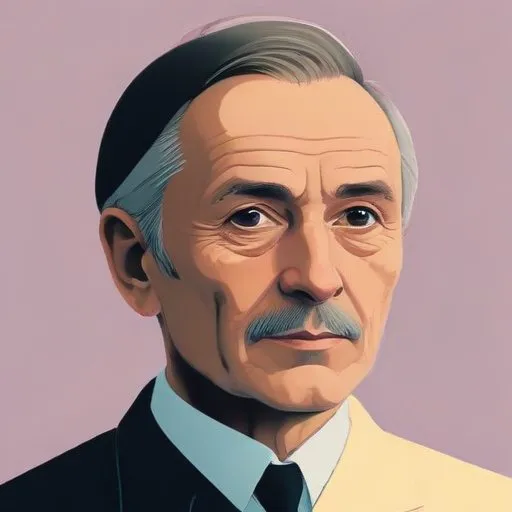
Gustav Naan: The Soviet Physicist and Philosopher Who Left a Lasting Impression
A Champion of Relativity and Cosmology
Gustav Naan, a renowned Soviet and Estonian physicist and philosopher, is best known for his groundbreaking work on the philosophical implications of the theory of relativity and his contributions to the fields of cosmology and demography. With a career spanning over three decades, Naan's research and writings had a significant impact on the scientific community, shaping the way we understand the universe and our place in it.
Early Life and Education
Born on May 17, 1919, in a village near Vladivostok, Russian SFSR, to a family of Estonian settlers, Naan's early life was marked by a strong sense of curiosity and a thirst for knowledge. He graduated from the Leningrad State University in 1941, and later joined the CPSU (Communist Party of the Soviet Union) in 1943. His loyalty to the communist ideology was reflected in his early writings, which were often critical of bourgeois nationalism and idealism.
Rise to Prominence
Naan's rise to prominence began in the late 1940s, when he published a series of articles on the philosophical implications of the theory of relativity. His 1948 article in Voprosy filosofii, a leading philosophical journal in the Soviet Union, sparked a heated debate among scholars. While his views were met with criticism from some quarters, Naan's unique perspective and tolerance on philosophic questions set him apart from his contemporaries.
Leadership and Academic Contributions
Naan's academic prowess and leadership skills earned him key positions in various institutions. He served as the director of the Institute of History of the Academy of Sciences of the Estonian SSR from 1950 to 1951 and as the Vice-President of the Academy of Sciences of the Estonian SSR from 1951 to 1964. Later, he worked at the Institute of Astrophysics and Atmosphere Physics of the Academy of Sciences of the Estonian SSR, where he continued to research and theorize on cosmology, cybernetics, and demography.
Legacy and Impact
Gustav Naan's contributions to the fields of physics, philosophy, and demography have left an indelible mark on the scientific community. His work on the theory of relativity and cosmology paved the way for future generations of scientists. Naan's legacy extends beyond the academic sphere, inspiring a new wave of thinkers and researchers to explore the mysteries of the universe.
Personal Milestones and Key Life Events
- May 17, 1919: Born in a village near Vladivostok, Russian SFSR
- 1941: Graduated from the Leningrad State University
- 1943: Joined the CPSU
- 1946: Graduated from the Higher Party School of the AUCP(b)
- 1948: Published article on the philosophical implications of the theory of relativity
- 1950-1951: Director of the Institute of History of the Academy of Sciences of the Estonian SSR
- 1951-1964: Vice-President of the Academy of Sciences of the Estonian SSR
- 1964-1994: Worked at the Institute of Astrophysics and Atmosphere Physics of the Academy of Sciences of the Estonian SSR
- January 12, 1994: Passed away in Tallinn, Estonia
Philosophical Contributions and Beliefs
Naan's philosophical contributions were shaped by his commitment to Marxist-Leninist ideology and his interest in the intersection of science and philosophy. He believed that scientific discoveries had the power to transform society and promote social justice. Throughout his career, Naan's writings reflected his commitment to dialectical materialism and his criticism of idealism and bougeois nationalism.
Influence on Modern Society
Gustav Naan's work has had a lasting impact on modern society, inspiring new generations of scientists, philosophers, and thinkers. His research on cosmology and demography has contributed to our understanding of the universe and our place within it. Naan's legacy serves as a reminder of the power of human ingenuity and the importance of interdisciplinary research.
FAQ
What were Gustav Naans main contributions to physics?
Gustav Naan made significant contributions to the fields of theoretical physics and philosophy. He is known for his work on the foundations of quantum mechanics and his critiques of positivism and empiricism.
What was Gustav Naans philosophical approach?
Gustav Naans philosophical approach combined elements of Kantianism, phenomenology, and existentialism. He argued that scientific knowledge is grounded in human experience and that philosophical inquiry should focus on the nature of reality and human existence.
How did Gustav Naans background influence his work?
Gustav Naans Russian-Estonian heritage and his experiences during World War I and the subsequent Russian Revolution shaped his philosophical outlook. His work reflects his concerns with the human condition, morality, and the role of science in society.
What were some of Gustav Naans notable publications?
Gustav Naan published several influential works, including The Foundations of Quantum Mechanics and The Crisis of Modern Science. His writings were widely discussed and debated in academic circles, contributing to ongoing philosophical and scientific discussions.
What was Gustav Naans legacy in physics and philosophy?
Gustav Naans legacy in physics and philosophy is one of innovative thinking and intellectual rigor. His work continues to inspire new generations of scholars, exploring the intersections of science, philosophy, and human experience.