


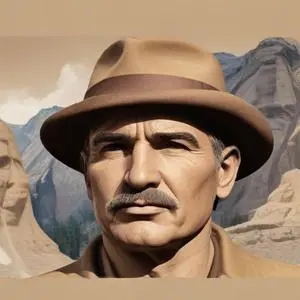
Designed the iconic Mount Rushmore presidential monument, carving four giant faces into South Dakota's Black Hills. This monumental work of art has become an American symbol and popular tourist attraction.
Gutzon Borglum is renowned for his iconic masterpiece, Mount Rushmore, a colossal sculpture that has become an emblem of American history and democracy. This Danish-American sculptor's magnum opus is a testament to his innovative vision, skill, and perseverance, earning him a place in the annals of American art and history.
Born on March 25, 1867, in St. Charles, Idaho Territory (now Utah), Borglum was the son of Danish immigrants Jens and Christina Borglum. His father, a woodcarver, and later a doctor, instilled in him a passion for art and craftsmanship. Borglum's early life was marked by his family's tumultuous experiences with Mormon polygamy, which eventually led to their departure from the church and their settlement in Omaha, Nebraska.
Borglum's artistic talent was nurtured in Omaha, where he apprenticed in a machine shop and graduated from Creighton Preparatory School. He later attended Saint Mary's College in Kansas, where he honed his skills in sculpture and drawing. The young artist's formative years were also influenced by his father's medical practice, which exposed him to the human form and its intricacies.
Borglum's big break came when he moved to New York City, where he sculpted saints and apostles for the New York Cathedral. His exceptional talent soon earned him recognition, and he began receiving commissions for public monuments and memorials. Some of his notable works from this period include the statues of Union General Philip Sheridan in Washington, D.C., and Chicago, as well as a bust of Abraham Lincoln exhibited in the White House.
In the 1920s, Borglum's fascination with monumental sculpture led him to envision a colossal tribute to American history. His idea was to carve the faces of four U.S. presidents – George Washington, Thomas Jefferson, Theodore Roosevelt, and Abraham Lincoln – into the granite face of Mount Rushmore in South Dakota. The project, which spanned 14 years, was marked by numerous challenges, including funding issues, harsh weather conditions, and personal struggles. Despite these obstacles, Borglum remained committed to his vision, and the project was finally completed in 1941, just months before his death.
Borglum's contribution to American art and culture is immeasurable. Mount Rushmore has become an iconic symbol of American democracy and a testament to the power of creative vision. His work has inspired generations of artists, sculptors, and historians, and continues to attract millions of visitors each year. Borglum's legacy extends beyond his art, too, as he played a significant role in shaping American identity and cultural heritage.
Borglum's art was deeply rooted in his philosophical beliefs about the power of human creativity and the importance of preserving American history. He once said, "The purpose of art is to express the inexpressible, to make the invisible visible, and to manifest the divine in human terms."
Through his work, Borglum demonstrated a profound respect for the human form, as well as a deep understanding of the cultural and historical context in which he worked. His legacy continues to inspire artists, historians, and enthusiasts alike, serving as a testament to the enduring power of art to capture the essence of the human experience.
Born in 1858
A pioneering leader who championed progressive reforms, trust-busting, and conservation, earning a Nobel Peace Prize for mediating the Russo-Japanese War. He's also famous for his rugged outdoorsmanship and "big stick" diplomacy.
Born in 1872
The 30th President of the United States, a lawyer and politician, led the country through a period of economic prosperity and limited government intervention, earning the nickname "Silent Cal" for his frugal and humble nature. He's most known for his minimalist approach to governance and tax cuts.
Born in 1874
The 31st President of the United States was a humanitarian and politician who led the country through the Great Depression and is known for his humanitarian efforts and infrastructure development. He's also infamous for his inability to mitigate the economic crisis.
Born in 1882
Led the United States through the Great Depression and World War II, implementing a series of reforms known as the New Deal and helping to establish the country as a global superpower.
