


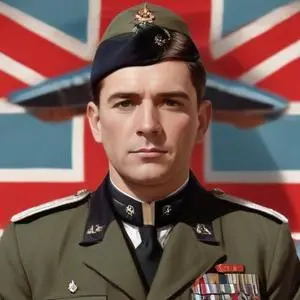
Led a daring WWII raid on German dams, earning the Victoria Cross for bravery and inspiring a legendary film. He was a pioneering pilot and leader in the British Royal Air Force.
Wing Commander Guy Gibson, a renowned bomber pilot in the Royal Air Force, is best known for leading the iconic Dam Busters raid in 1943, which resulted in the breaching of two large dams in the Ruhr area of Germany. This daring operation earned him the Victoria Cross, the highest award for gallantry in the face of the enemy that can be awarded to British and Commonwealth forces.
Gibson was born on August 12, 1918, in Simla, British India, to Alexander James Gibson and his wife Leonora Nora Mary Gibson. His father, an officer in the Imperial Indian Forestry Service, later became the Chief Conservator of Forests for the Simla Hill States in 1922.
After his parents' separation in 1924, Gibson's mother returned to England with her children, settling in Penzance, Cornwall. Gibson started school in England at West Cornwall College, later moving to Earls Avenue School in Folkestone, Kent. In 1932, he joined St Edwards School, Oxford, where he was in the same house as Douglas Bader.
Gibson joined the Royal Air Force in 1936, training as a pilot at RAF Prestwick. He earned his wings in 1937 and was commissioned as a pilot officer in 1938. During the early years of World War II, Gibson flew with No. 83 Squadron, participating in various bombing missions over Europe.
In March 1943, Gibson was appointed the first commanding officer of No. 617 Squadron, tasked with executing Operation Chastise, the Dam Busters raid. On May 16, 1943, Gibson led the squadron in a daring low-level bombing mission, breaching the Möhne and Edersee dams in Germany. This operation earned him the Victoria Cross, and he became the most highly decorated British serviceman at the time.
Gibson's personal life was marked by turmoil, with his mother struggling with alcoholism and his parents' separation at an early age. Despite these challenges, Gibson developed strong relationships with his siblings and developed a passion for flying.
Gibson's legacy is one of bravery, innovation, and leadership. His daring Dam Busters raid has become an iconic symbol of British determination and ingenuity during World War II. He completed over 170 war operations before being killed in action at the age of 26.
Gibson's story has inspired numerous books, films, and documentaries, cementing his place as one of the most celebrated war heroes of all time.
Born in 1871
Prolific writer of historical novels and adventure stories, also a talented landscape painter.
Born in 1917
A highly decorated WWII bomber pilot who later dedicated his life to helping the disabled and founding the Cheshire Homes charity, earning him a Nobel Peace Prize nomination.
Born in 1910
A British Royal Air Force flying ace during World War II, known for his bravery and flying skills despite having two prosthetic legs. He was a symbol of inspiration and determination.
