


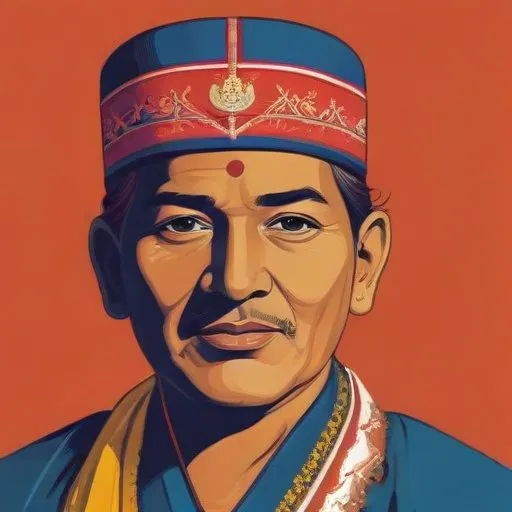
The last ruler of the Nepalese monarchy, who reigned from 2001 to 2008 and was known for his attempts to consolidate power and suppress democracy. He was eventually forced to accept a constitutional monarchy and later abolished.
Gyanendra Bir Bikram Shah Dev, the last king of Nepal, is known for his tumultuous reign that lasted from 2001 to 2008, marked by controversies and struggles for power. He ascended to the throne following the royal massacre of 2001, in which his brother, King Birendra, and several other members of the royal family were killed.
Gyanendra was born on July 7, 1947, in Kathmandu, Nepal, to King Mahendra and Queen Ratna. He was the younger brother of King Birendra and was not in line for the throne initially. However, after King Birendra's death, Gyanendra ascended to the throne, sparking controversy and doubts about his role in the royal massacre.
Gyanendra's reign was marked by several controversies, including the 2001 royal massacre, his subsequent takeover of power, and his attempts to consolidate power and suppress democracy. He faced opposition from the Nepalese people, who demanded democracy and an end to the monarchy. In 2005, he seized absolute power, dissolving the government and imposing a state of emergency, leading to widespread criticism and international pressure.
In 2006, Gyanendra was forced to restore the country's parliament and relinquish his power following a 19-day general strike and mass protests. Two years later, in 2008, the Nepalese Constituent Assembly voted to abolish the monarchy, ending Gyanendra's reign and the 240-year-old Shah dynasty. Today, Gyanendra is largely seen as a symbol of the country's tumultuous past, and his legacy remains a topic of debate among Nepalese citizens.
Gyanendra is married to Komal Rajya Lakshmi Devi Shah, and they have two children, Paras and Prerana. He is said to have a net worth of around $200 million, largely inherited from his royal family's assets and properties.
Gyanendra's beliefs and philosophies are largely shrouded in mystery, with many critics accusing him of being authoritarian and opposed to democratic values. However, in his few public statements, he has emphasized the need for national unity and stability, highlighting the importance of the monarchy in Nepal's history and culture.
Gyanendra's reign and subsequent downfall have had a significant impact on modern Nepalese society, paving the way for democratic reforms and the country's transition to a federal republic. His legacy serves as a reminder of the country's struggle for democracy and the importance of accountability and transparency in governance.
Gyanendra's reign took place during a period of significant political and social change in Nepal, marked by the rise of Maoist insurgents and demands for democracy. His downfall marked the end of the Shah dynasty and the beginning of a new era in Nepalese politics, paving the way for democratic reforms and the country's transition to a federal republic.
Gyanendra's reign can be compared to that of other authoritarian leaders who struggled to adapt to democratic reforms, such as King Fahd of Saudi Arabia or King Hassan II of Morocco. His downfall serves as a reminder of the importance of democratic values and the need for leaders to adapt to changing times.
Gyanendra's personal relationships and anecdotes are largely unknown, with many critics accusing him of being isolated and disconnected from the Nepalese people. However, his marriage to Komal Rajya Lakshmi Devi Shah has been described as a strong and supportive partnership.
Gyanendra's reign and subsequent downfall have had a significant impact on Nepalese pop culture, inspiring numerous songs, films, and books about the royal family and the country's struggle for democracy.
Gyanendra has received several awards and honors, including the Order of the Star of Nepal, the Order of the Mahendra Chain, and the Order of Tri Shakti Patta.
Gyanendra's educational contributions are limited, with many critics accusing him of prioritizing his own power and interests over the welfare of the Nepalese people. However, he has supported several educational initiatives and institutions, including the Tribhuvan University and the Nepal Academy.
Gyanendra's reign was marked by several scandals, including allegations of corruption, human rights abuses, and his role in the royal massacre. While he has not publicly acknowledged any wrongdoing, his downfall and subsequent loss of power can be seen as a form of redemption for the Nepalese people.
Gyanendra's future remains uncertain, with many speculating about his role in Nepalese politics and his potential influence on the country's development. While he has largely remained out of the public eye, his legacy continues to shape Nepal's political landscape.
Gyanendra has supported several charitable organizations and initiatives, including the Nepal Red Cross Society, the Rotary Club of Nepal, and the King Mahendra Trust for Nature Conservation. He has also worked to promote Nepalese culture and heritage, supporting several cultural institutions and festivals.
Gyanendra's story serves as a reminder of the importance of accountability and transparency in governance, highlighting the need for leaders to adapt to changing times and prioritize the welfare of their people.
