


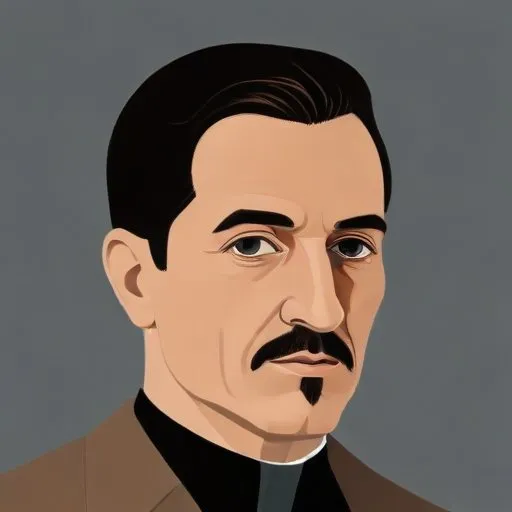
Developed influential theories in thermodynamics and electromagnetism, and made significant contributions to the field of mathematics, particularly in the area of linear algebra.
Gyula Farkas, a Hungarian mathematician and physicist, is renowned for his significant contributions to the fields of mathematics and physics, particularly in the study of thermodynamics, electromagnetism, and theoretical mechanics. His work laid the foundation for future generations of scientists, earning him a prominent place in the annals of scientific history.
Born on March 28, 1847, in Srosd, Hungary, Farkas was the eldest of seven children in a Roman Catholic Hungarian noble family. His family moved frequently during his childhood, but he eventually attended the gymnasium at Gyr Raab, where he was encouraged towards physics by nyos Jedlik.
Farkas's academic pursuits took him from studying law and music at Pest to eventually focusing on physics and chemistry. He worked as a private tutor and later taught in a secondary school at Szkesfehrvr Stuhlweissenburg, where he presented his paper at the Hungarian Academy of Science. This paper caught the attention of Lorand Eotvos, who subjected it to critique.
Farkas's research opportunities expanded when he became a tutor for Count Gza Batthyanys children. During this time, he conducted research in mathematics and physics using a specially designed physics laboratory. His work in this laboratory led to significant contributions to the field of thermodynamics, particularly in the study of entropy and the laws of thermodynamics.
Farkas's work had a profound impact on the development of modern physics and mathematics. His research in thermodynamics laid the groundwork for the understanding of energy and its applications. His work also influenced the development of electromagnetic theory and theoretical mechanics.
Farkas's family was deeply rooted in Hungarian nobility, and his nephew, vitz Ferenc Farkas de Kisbarnak, went on to become the Chief Scout of the Hungarian Boy Scouts and a commanding officer of the Royal Ludovica Military Academy.
Farkas's family was also steeped in academic tradition, as evidenced by his other nephew, Gyula Farkas de Kisbarnak, who became a literary historian, Finno-Ugric linguist, and professor at the University of Gttingen.
Gyula Farkas's contributions to the fields of mathematics and physics have stood the test of time. His work continues to influence modern scientific inquiry, and his name is synonymous with excellence in Hungarian scientific circles.
Farkas's life and work serve as a testament to the power of dedication and perseverance in the pursuit of knowledge. His legacy continues to inspire future generations of scientists and mathematicians.
Gyula Farkas's remarkable life and work have left an indelible mark on the world of science. His groundbreaking contributions continue to shape our understanding of the natural world, inspiring generations to come.
Born in 1862
A renowned mathematician and academic who developed infinite-dimensional vector spaces and laid the foundation for quantum mechanics and relativity. He's also famous for his 23 unsolved math problems that shaped 20th-century mathematics.
Born in 1854
A pioneer in mathematics and physics, he laid the foundations for modern chaos theory, topology, and relativity, making groundbreaking contributions to our understanding of space and time.
Born in 1882
A pioneering mathematician and physicist who revolutionized abstract algebra and made groundbreaking contributions to modern physics, particularly in the development of Einstein's theory of general relativity.
Born in 1849
A pioneer in geometry and group theory, known for developing the Erlangen program, which unified various geometries under a single framework. His work laid foundations for modern algebraic geometry and topology.
Born in 1842
Developed influential theories on continuous symmetry and introduced the concept of Lie groups, which have far-reaching implications in modern physics and mathematics.
Born in 1777
A pioneer in mathematics and physics, he made major contributions to number theory, algebra, and electromagnetism, shaping our understanding of the natural world.
Born in 1802
A pioneer in mathematics, he made groundbreaking contributions to the field of algebra, particularly in the development of group theory and the proof of the impossibility of solving quintic equations using radicals.
