


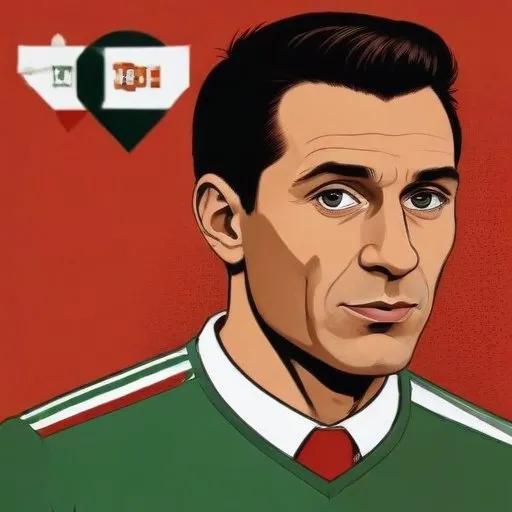
A Hungarian footballer and manager who led teams to numerous championships and developed the " WM" formation, revolutionizing the sport. Known for his innovative tactics and successful coaching career.
Gyula Lrnt, born Gyula Lipovics, was a Hungarian footballer and manager of Croatian descent, renowned for his exceptional skills as a defender and midfielder, and later, his successful coaching career. He is most famously known for being a prominent member of the legendary Hungarian national team, the Mighty Magyars, which included iconic players like Ferenc Puskás, Zoltán Czibor, Sándor Kocsis, József Bozsik, and Nándor Hidegkuti.
Born on February 6, 1923, in Hungary, Lrnt's father was a policeman who fought as a volunteer in World War II on the German side. Lrnt turned professional footballer at the age of 16, simultaneously studying economics at university in the 1950s. He began his career as a youth with his hometown club, Kszeg SE, after encouragement from a local trainer.
He then played for Nagyvárad AC and UT Arad in Romania, before his career prospered at Vasas SC, where his teammates included Ladislao Kubala. However, in January 1949, as Hungary became a communist state, Kubala fled the country, and Lrnt attempted to escape, but was captured and ended up in a detention camp.
After his release from detention, thanks to the intervention of Gusztáv Sebes, the national team coach, Lrnt made his debut for Hungary on October 19, 1949, in an away game against Austria. He went on to become an integral part of the legendary Mighty Magyars team, which dominated international football in the 1950s.
Lrnt's impressive performance on the field earned him 39 caps for Hungary, scoring 10 goals between 1949 and 1956. During this period, the Mighty Magyars won the 1952 Olympic Games, finished as runners-up in the 1954 World Cup, and achieved 42 consecutive unbeaten matches.
After retiring as a player, Lrnt became a coach, managing several clubs, including Honvéd, FC Bayern Munich, and PAOK Thessaloniki FC. His most notable achievement as a coach was guiding PAOK to a Greek Championship title in 1976.
Lrnt's coaching career was cut short when he suffered a heart attack while watching PAOK play Olympiacos CFP on May 31, 1981, and died at the age of 58. Despite his untimely passing, Lrnt's legacy as a player and coach continues to inspire future generations of footballers and coaches.
Gyula Lrnt's remarkable journey as a player and coach left an indelible mark on Hungarian football, and his legacy continues to inspire future generations of football enthusiasts.
99 Years Old
A legendary Hungarian footballer and manager who scored 746 goals in 629 games, leading his national team to the 1954 World Cup final and winning four Hungarian championships. He's a iconic figure in the sport, known for his incredible goal-scoring ability and innovative tactics.
Born in 1925
A Hungarian footballer and manager who won two Olympic titles and played in four World Cups, known for his exceptional skills and leadership on the pitch.
Born in 1922
A Hungarian football legend who revolutionized the sport with his innovative "deep-lying center-forward" position, leading his team to numerous victories and earning him a place in football history.
Born in 1899
A Hungarian football legend who coached Benfica to unprecedented success, winning two European Cups, and is infamous for placing a curse on the team after leaving.
Born in 1914
Hungarian footballer and manager who led the national team to the 1954 World Cup final and is credited with developing the innovative "Aranycsapat" (Golden Team) playing style.
