


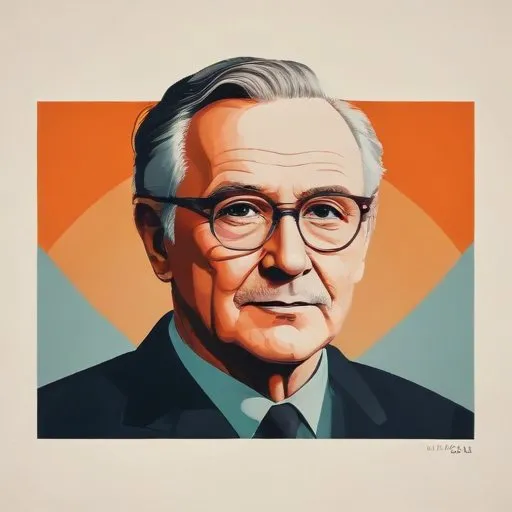
Developed the first nuclear bomb and made significant contributions to nuclear physics, earning him the Enrico Fermi Award.
Harold Melvin Agnew, a renowned American physicist, is best known for being the only scientist to have flown as an observer on the historic Hiroshima bombing mission and later becoming the third director of the Los Alamos National Laboratory. His remarkable journey spanned over six decades, leaving an indelible mark on the world of physics and beyond.
Born on March 28, 1921, in Denver, Colorado, Agnew grew up as the only child of stonecutters. He excelled in academics and athletics, graduating Phi Beta Kappa from the University of Denver with a Bachelor of Arts degree in chemistry. A strong athlete, he even pitched for the university softball team that won a championship.
After the Japanese bombing of Pearl Harbor, Agnew attempted to join the United States Army Air Corps with his girlfriend Beverly. However, he was soon recruited by the Metallurgical Laboratory at the University of Chicago, where he worked on the development of the first nuclear reactor, Chicago Pile-1. In 1943, he joined the Los Alamos Laboratory, where he contributed to the Cockcroft-Walton generator project.
Agnew's post-war career was marked by numerous achievements. He completed his graduate work under the guidance of Enrico Fermi and returned to Los Alamos in 1949. He played a crucial role in the Castle Bravo nuclear test at Bikini Atoll in 1954 and later became the head of the Weapon Nuclear Engineering Division in 1964.
In addition to his scientific pursuits, Agnew served as a Democratic New Mexico State Senator from 1955 to 1961 and as the Scientific Adviser to the NATO Supreme Allied Commander Europe (SACEUR) from 1961 to 1964. He became the director of the Los Alamos National Laboratory from 1970 to 1979, before resigning to become President and Chief Executive Officer of General Atomics.
Agnew's remarkable career was marked by numerous accolades, including his induction into the National Academy of Engineering and the receipt of the Enrico Fermi Award. His work had a profound impact on the development of nuclear physics and policy, shaping the course of modern history.
Through his life and work, Agnew demonstrated an unwavering commitment to science, public service, and humanity. His legacy continues to inspire future generations of scientists, policymakers, and leaders, ensuring that his remarkable story will be remembered for years to come.
Born in 1901
A pioneer in nuclear physics, known for leading the team that developed the first nuclear reactor and playing a crucial role in the development of the atomic bomb.
Born in 1904
Leading the development of the atomic bomb during World War II, this brilliant mind made groundbreaking contributions to theoretical physics, pushing the boundaries of human understanding.
Born in 1918
A brilliant physicist and engineer who pioneered quantum mechanics and famously explained complex concepts in simple terms, making science accessible to all.
Born in 1906
A renowned physicist and Nobel laureate who made groundbreaking contributions to our understanding of the universe, particularly in the fields of nuclear physics and astrophysics.
Born in 1908
Developed the hydrogen bomb and was a key figure in the development of the US nuclear program, known for his advocacy of nuclear energy and his role in the Cold War.
Born in 1923
A renowned physicist and mathematician who made groundbreaking contributions to quantum electrodynamics and futurism, proposing innovative ideas like the Dyson sphere.
