


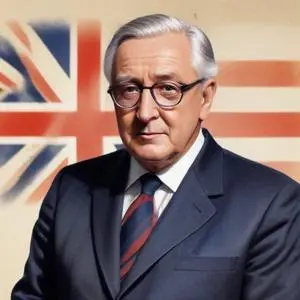
A British politician who served as Prime Minister from 1964 to 1970 and again from 1974 to 1976, known for his role in shaping the country's economy and foreign policy.
Harold Wilson, the twice-serving Prime Minister of the United Kingdom, left an indelible mark on British politics and society. As the leader of the Labour Party from 1963 to 1976, Wilson oversaw a transformative era of social and economic change, cementing his place as one of the most influential figures of the 20th century.
Born in Huddersfield, Yorkshire, on March 11, 1916, Wilson was nurtured in a politically active middle-class family. His academic prowess earned him a place at Jesus College, Oxford, where he studied Philosophy, Politics, and Economics (PPE). Later, he became an Economic History lecturer at New College, Oxford, and a research fellow at University College, Oxford.
Wilson's entry into politics was swift and decisive. Elected to Parliament in 1945, he was appointed to the Attlee government as a Parliamentary Secretary, becoming Secretary for Overseas Trade in 1947, and later elevated to the Cabinet as President of the Board of Trade. Following Labour's defeat at the 1955 election, Wilson joined the Shadow Cabinet, serving as Shadow Chancellor and later Shadow Foreign Secretary.
When Labour Leader Hugh Gaitskell died suddenly in January 1963, Wilson won the subsequent leadership election, becoming Leader of the Opposition. He led Labour to a narrow victory at the 1964 election, and his first period as prime minister saw a period of low unemployment and economic prosperity. However, significant problems with Britain's external balance of payments hindered his government's progress.
Despite these challenges, the Wilson government oversaw significant societal changes, including:
Wilson's government also armed Nigeria during the Biafran War and, in 1969, sent British troops to Northern Ireland. His leadership was marked by a commitment to social justice, economic reform, and international cooperation.
Wilson's personal life was marked by a strong sense of duty and public service. He was married to Mary Baldwin from 1940 until his death in 1995. The couple had two sons, Robin and Giles. Wilson was created a life peer in 1983, taking the title Baron Wilson of Rievaulx.
Harold Wilson's legacy extends far beyond his terms in office. His commitment to social reform, economic development, and international cooperation continues to inspire generations of politicians, academics, and activists. As a champion of the common person, Wilson's politics were guided by a profound sense of empathy and a desire to create a more just and equal society.
In the words of Wilson himself, "The Labour Party is a crusade or it is nothing." His life's work remains a testament to the power of progressive politics and the enduring impact of visionary leadership.
Wilson's premiership coincided with a tumultuous period in world history, marked by the Cold War, decolonization, and social unrest. His leadership navigated these challenges with a steady hand, forging a path that balanced economic growth with social justice.
In the end, Harold Wilson's life and legacy serve as a powerful reminder of the transformative potential of politics and the enduring importance of progressive values in shaping a better future for all.
73 Years Old
The former Prime Minister of the United Kingdom who led the country through a transformative period, including the Iraq War, and is known for his charismatic leadership and controversial decisions.
75 Years Old
The Prime Minister of the United Kingdom from 2007 to 2010, known for his key role in shaping the country's economy and response to the 2008 global financial crisis.
Born in 1912
A British politician who served as Prime Minister from 1976 to 1979, known for his efforts to stabilize the economy and navigate the country through a period of industrial unrest.
Born in 1916
The Prime Minister who led the UK into the European Economic Community (EEC) and navigated the country through a period of economic and industrial turmoil. He's also known for his diplomatic efforts, particularly in regards to the Cold War.
Born in 1903
A British aristocrat who served as Prime Minister from 1963 to 1964, known for his brief tenure and aristocratic background.
Born in 1871
Prolific writer of historical novels and adventure stories, also a talented landscape painter.
Born in 1883
Led the Labour Party to a landslide victory in 1945, implementing significant social and economic reforms, including the creation of the National Health Service. He played a crucial role in shaping post-war Britain.
Born in 1897
A British politician who served as Prime Minister from 1955 to 1957, known for his role in the Suez Crisis and his diplomatic efforts during the Cold War.
