


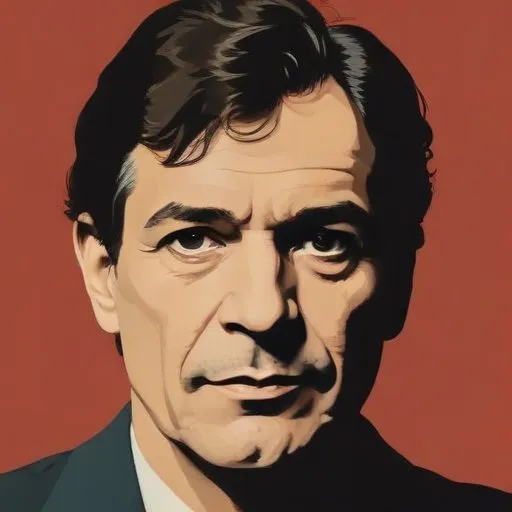
Experimental filmmaker and video artist who explores the relationship between image, politics, and ideology through critical and thought-provoking works.
Harun Farocki, a renowned German filmmaker, author, and lecturer, is best known for his groundbreaking work in experimental documentaries, particularly in the realm of non-narrative essays on the politics of imagery. His innovative approach to filmmaking, which spanned over four decades, has had a profound impact on the film industry and beyond.
Born as Harun El Usman Faroqhi on January 9, 1944, in Neutitschein, Czech Republic, Farocki's life was marked by cultural diversity and global mobility. His father, Abdul Qudus Faroqui, had immigrated to Germany from India in the 1920s, while his German mother had been evacuated from Berlin due to the Allied bombing of Germany. Farocki grew up in India and Indonesia before settling in Hamburg in 1958.
Farocki's fascination with filmmaking was heavily influenced by the likes of Bertolt Brecht and Jean-Luc Godard. He studied at the German Film and Television Academy Berlin (dffb) from 1966 to 1968, where he began making films that would shape his unique style and perspective.
Farocki's prolific career saw the creation of over 90 films, most of which were short experimental documentaries. His notable works include:
Farocki's expertise extended beyond filmmaking, as he taught at the University of California, Berkeley, from 1993 to 1999, and later became a professor at the Academy of Fine Arts Vienna. His legacy continues to inspire filmmakers, scholars, and artists, with his work being exhibited in prominent institutions such as the Carnegie Museum of Art and the Museum of Modern Art.
Farocki's contributions to the film industry have been recognized with numerous awards and honors, including retrospectives at the Tate Modern in 2009 and the Museum of Modern Art in 2011.
Farocki's personal life was marked by his marriage to Ursula Lefkes, with whom he had a son. He passed away on July 30, 2014, at the age of 70, leaving behind a legacy that continues to shape the film industry and beyond.
Farocki's groundbreaking work has had a profound impact on modern society, influencing filmmakers, scholars, and artists. His exploration of the politics of imagery, operational images, and the relationship between war and technology has opened up new avenues of inquiry and creative expression.
As a pioneering filmmaker and theorist, Harun Farocki's legacy continues to inspire and influence generations of creatives, ensuring his work remains relevant and thought-provoking for years to come.
95 Years Old
A pioneer of French New Wave cinema, known for experimental and provocative films that challenged traditional narrative structures and explored themes of politics, philosophy, and social commentary.
83 Years Old
Acclaimed filmmaker behind gritty, intense, and visually stunning movies that often explore themes of redemption, faith, and the human condition, with a distinctive directing style that blends violence and artistry.
87 Years Old
Academy Award-winning filmmaker behind epic movies like The Godfather and Apocalypse Now, known for his groundbreaking storytelling and direction.
84 Years Old
A visionary filmmaker who explores the human condition through provocative, visually stunning, and often unconventional documentaries and feature films. Known for his intense, poetic, and philosophical storytelling style.
81 Years Old
A prolific filmmaker who explored themes of social inequality, identity, and human relationships through his provocative and emotionally charged movies, leaving an indelible mark on New German Cinema.
87 Years Old
German New Wave pioneer behind films like "The Tin Drum" and "Death of a Salesman", known for adapting literary classics into cinematic masterpieces.
81 Years Old
A renowned filmmaker acclaimed for his poignant and visually stunning works that often explore the human condition, particularly in the context of identity, culture, and social change.
