


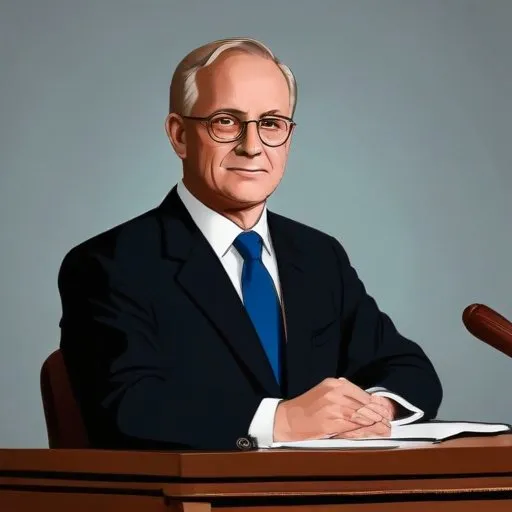
A prominent figure in Wisconsin politics, serving as a state legislator and judge, known for his advocacy of progressive reforms and labor rights.
Harvey Putnam was a renowned American lawyer and politician who left an indelible mark on the country's political landscape. He is best known for his service as a Whig member of the U.S. House of Representatives and the New York Senate, where he championed various causes and advocated for the rights of his constituents.
Born on January 5, 1793, in Brattleboro, Windham County, Vermont, Putnam was the youngest of nine children to Asa Putnam and Anna Collins Putnam. After his father's untimely death, he moved to Williamstown, Massachusetts, and later to Cobleskill, New York, to live with relatives. Putnam attended common schools and pursued his interest in law, studying in Skaneateles, New York. To support himself, he took up teaching, a profession that would later serve him well in his political career.
In 1816, Putnam was admitted to the bar and began practicing law in Attica, New York. His dedication and perseverance earned him recognition, and he soon became involved in politics. He held various offices in Attica, including town clerk and supervisor, before being elected as a Whig to the 25th United States Congress in 1838. This marked the beginning of his illustrious political career, which would span over a decade.
Putnam's accomplishments in Congress were numerous. He served in the 25th, 30th, and 31st Congresses, focusing on issues such as infrastructure development, education, and agriculture. In 1840, he was appointed Surrogate of Genesee County and later of Wyoming County, a position he held until 1843. He was then elected to the New York State Senate, where he represented the 8th District from 1843 to 1846.
On August 5, 1817, Putnam married Myra Osborne of Skaneateles, New York, and the couple had a son, James O. Putnam, who would later become a New York State Senator and U.S. Minister to Belgium. Putnam's contributions to American politics and law are still remembered today. He passed away on September 20, 1855, in Attica, and is interred in Forest Hill Cemetery.
Harvey Putnam's dedication to public service and his commitment to the principles of democracy have left a lasting impact on American politics. His legacy serves as a testament to the power of hard work, perseverance, and a passion for serving others.
Born in 1809
Led the United States through its Civil War and ultimately abolished slavery, leaving a lasting legacy in American history.
Born in 1822
Led the Union Army to victory in the Civil War and later became President, known for issuing the Emancipation Proclamation and strengthening federal authority.
Born in 1822
The 19th President of the United States, a general, lawyer, and politician who ended the Reconstruction era and withdrew federal troops from the South, allowing Racial Segregation to begin. He's also known for being a strong supporter of education and civil service reform.
Born in 1831
The 20th President of the United States was a multifaceted leader who served as a general in the Civil War and later became a lawyer and politician, known for his strong advocacy for education and civil rights. He's also infamous for being assassinated just six months into his presidency.
Born in 1829
The 21st President of the United States, a strong advocate for civil service reform, is most known for signing the Pendleton Civil Service Act, which transformed the federal government's hiring practices. He's also remembered for his unexpected rise to presidency after the assassination of James A. Garfield.
Born in 1837
The first Democrat elected after the Civil War, he served two non-consecutive terms, earning him a unique spot in history, and is often remembered for his strong leadership and commitment to limited government.
Born in 1833
The 23rd President of the United States was a prominent leader who oversaw the admission of six new states to the Union and supported education and conservation efforts. He's also known for being the grandson of William Henry Harrison, the 9th President.
Born in 1843
The 25th President of the United States, a strong leader who championed high tariffs and annexed Hawaii, is most known for being assassinated at the 1901 World's Fair. He played a significant role in shaping the country's economy and foreign policy.
