


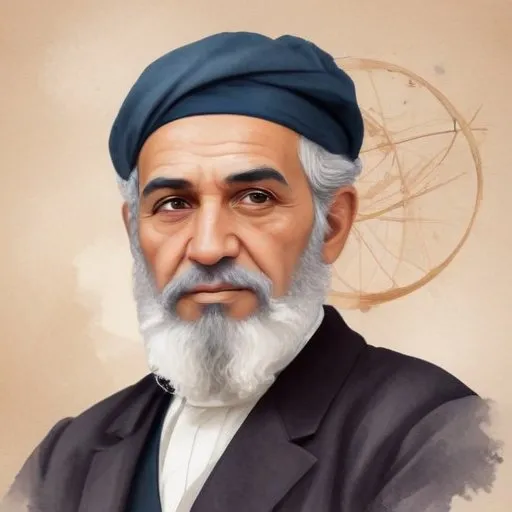
A 17th-century polymath who made significant contributions to astronomy, mathematics, and philosophy, particularly in the fields of trigonometry and astronomy, leaving a lasting impact on the Ottoman Empire's scientific community.
Hasan Tahsini, a renowned Albanian alim, astronomer, mathematician, and philosopher, left an indelible mark on the intellectual landscape of the Ottoman Empire in the 19th century. As the first rector of Istanbul University and one of the founders of the Central Committee for Defending Albanian Rights, Tahsini's contributions to education, philosophy, and science continue to inspire generations of scholars and thinkers.
Born on April 7, 1811, in the village of Ninat, Konispol, then part of the Ottoman Empire, Tahsini was born into a family of ulama. His father, Osman Efendi Rushiti, played a significant role in shaping his early education and instilling in him a passion for learning. Tahsini's intellectual curiosity was further nurtured when he worked as a tutor to the sons of Hayrullah Efendi, the Minister of Education of the Ottoman Empire.
In 1839, Tahsini was appointed to the staff of the Ottoman school in Paris, where he taught Turkish and religious sciences while pursuing his own studies in mathematics and natural sciences at the University of Paris. This 12-year sojourn in Paris had a profound impact on Tahsini's intellectual development, exposing him to Western philosophical and scientific traditions that would later inform his own teachings and writings.
In 1870, Tahsini returned to the Ottoman Empire and was appointed the first rector of Istanbul University, a position that allowed him to introduce Western European methods and ideologies into the traditional Islamic curriculum. As a champion of liberal reform, Tahsini's emphasis on science, reason, and critical thinking earned him both acclaim and criticism from conservative ulama circles.
Tahsini's philosophical contributions were shaped by his exposure to Western thinkers such as René Descartes and François-René de Chateaubriand. He believed in the importance of empirical evidence, reason, and observation in understanding the natural world. His teachings on psychology, astronomy, and physics emphasized the importance of experimentation and empirical research, earning him the ire of conservative scholars who saw his methods as a threat to traditional Islamic values.
Tahsini's legacy extends beyond the boundaries of the Ottoman Empire. His emphasis on liberal reform, scientific inquiry, and critical thinking has inspired generations of scholars, educators, and thinkers in the region and beyond. As a pioneering figure in the modernization of Islamic education, Tahsini's contributions continue to shape the intellectual landscape of the Middle East and beyond.
Tahsini's life and work must be situated within the broader context of the Ottoman Empire's attempts to modernize and Westernize in the 19th century. His contributions can be compared to those of other prominent scholars of the era, such as Jamal al-Din al-Afghani and Muhammad Abduh, who also sought to reconcile traditional Islamic values with Western philosophical and scientific traditions.
Tahsini's life serves as a testament to the power of human curiosity, perseverance, and intellectual courage. His commitment to liberal reform, education, and scientific inquiry inspires us to strive for excellence, to challenge tradition, and to embrace the pursuit of knowledge as a lifelong journey.
Born in 1846
A renowned poet and translator who played a significant role in popularizing Albanian literature and culture, especially during the Ottoman Empire era.
Born in 1611
A 17th-century Ottoman explorer and writer who traveled extensively throughout the Middle East, Europe, and Africa, documenting his journeys and cultural observations in a 10-volume book. He is most known for his vivid descriptions of people, places, and customs, providing valuable insights into the social and cultural history of the time.
