


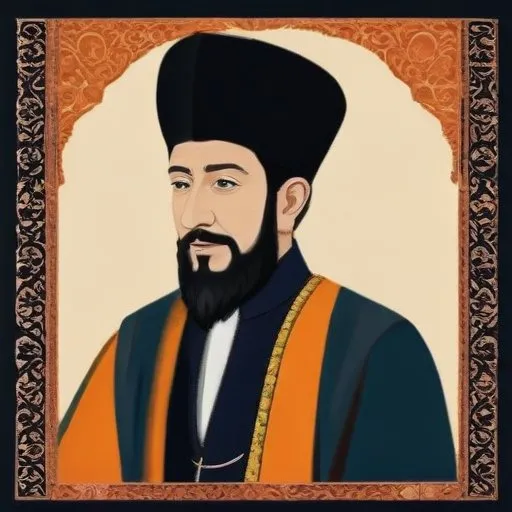
A 16th-century Persian prince who played a key role in the Ottoman-Safavid War and was a notable figure in the Safavid dynasty's royal court. He's known for his military campaigns and diplomatic efforts.
Haydar Mirza Safavi, a Persian prince, is notorious for his brief and tumultuous reign as the Shah of Iran, lasting merely a day, from May 15, 1576, to May 15, 1576.
Born on September 18, 1554, Haydar Mirza was the son of Tahmasp I, the second Shah of the Safavid Empire, and Sultanzadeh Khanum, a Georgian noblewoman. His mother's siblings, Aman Beg and Ali Khan Beg, were influential noblemen who played a significant role in the Safavid court.
During Tahmasp I's illness in 1574, the Qizilbash tribes, the powerful military clans that supported the Safavid Empire, began to discuss potential successors. The Ustalju and Shaykhavand clans, along with the Georgian nobles, favored Haydar Mirza, while the Rumlu, Afshar, and Qajar clans supported his brother, Ismail Mirza Safavi, who was imprisoned in the Qahqaheh Castle.
As Tahmasp I's health began to deteriorate, the pro-Haydar Mirza faction attempted to eliminate Ismail Mirza Safavi. However, Pari Khan Khanum, Tahmasp's daughter, discovered the plot and informed her father, who subsequently sent Afshar musketeers to protect Ismail Mirza.
Following Tahmasp I's recovery, Haydar Mirza remained by his side, and upon his father's death on May 14, 1576, he declared himself the new Shah of Iran. Nevertheless, his reign was short-lived, as the Qizilbash tribes, who favored Ismail Mirza, killed Haydar Mirza on the same day.
Haydar Mirza Safavi's brief reign and tragic fate serve as a testament to the complexities and rivalries within the Safavid court. His story highlights the struggles for power and the delicate balance of alliances that defined the empire's politics.
Haydar Mirza's life and reign occurred during a tumultuous period in the Safavid Empire, marked by struggles for power, succession crises, and external threats from the Ottoman Empire. His story serves as a microcosm of the larger historical context, highlighting the intricate web of alliances and rivalries that shaped the empire's politics.
Born in 1772
The second ruler of the Qajar dynasty, he's known for his military campaigns, administrative reforms, and cultural achievements, including the development of Persian literature and art. He also established Tehran as the capital of Iran.
