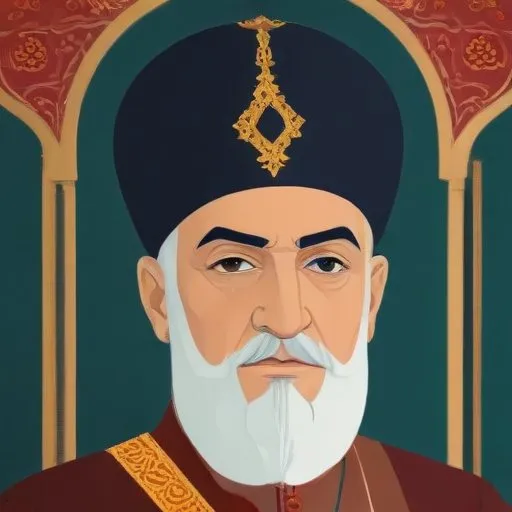
FathAli Shah Qajar: The Embodiment of Persian Grandeur
Reign and Legacy
FathAli Shah Qajar, the second Shah of Qajar Iran, is renowned for his impressive reign from 17 June 1797 until his death on 24 October 1834. He is famously associated with the irrevocable ceding of Iran's northern territories in the Caucasus to the Russian Empire following the Russo-Persian Wars of 1804-1813 and 1826-1828.
Early Life and Family
Born in May 1769 in the city of Damghan, FathAli Shah was the eldest son of Hossein Qoli Khan Qajar, brother of Agha Mohammad Khan Qajar, and the daughter of Mohammad Agha Ezz al-Dinlu of the Ashaqabash branch of the Qajar tribe. He was called FathAli, a name borne by his prominent great-grandfather, FathAli Khan Qajar, and was mainly known by his second name of Baba Khan until his coronation in 1797.
Visual Representations and Imperial Ambitions
FathAli Shah commissioned numerous visual portrayals of himself and his court, including rock reliefs next to those erected under the pre-Islamic Sasanian Empire (224-651) in Ray, Fars, and Kermanshah. This was done to represent himself as the heir to the ancient Persian empire, solidifying his legitimacy and authority in the eyes of his countryfolk and future generations.
Economic and Military Challenges
Towards the end of his reign, FathAli Shah faced significant economic problems and military and technological liabilities, which brought Iran to the verge of governmental disintegration. His struggles with the Russian Empire and internal power struggles ultimately led to a tumultuous struggle for the throne following his death.
The Shah was known for his exceptional physical stature, boasting an exceptionally long beard and a wasplike waist. His numerous progeny also contributed to his legendary status in Iranian history. Historian Joseph M. Upton notes that these physical attributes and familial accomplishments have cemented FathAli Shah's place in the annals of Iranian history.
Historical Context and Legacy
FathAli Shah's reign marks a significant turning point in Iranian history, as the country began to confront the encroaching Russian Empire and the rise of European powers. His actions, though sometimes criticized, reflect the complexities and challenges of Iran's position in the early 19th century. Despite controversies and difficulties, FathAli Shah remains an important figure in Iranian history, remembered for his grandeur, ambition, and the lasting impact of his reign.
Personal Milestones and Key Life Events
- May 1769: Born in Damghan, Iran
- 17 June 1797: Coronation as the second Shah of Qajar Iran
- 1804-1813 and 1826-1828: Russo-Persian Wars, resulting in the loss of northern territories to the Russian Empire
- 24 October 1834: Death, marking the beginning of a tumultuous struggle for the throne
Trivia and Fun Facts
- The Russians referred to FathAli Shah as Baba Khan until 1813, as they refused to recognize his rule.
- FathAli Shah's reign saw the creation of numerous rock reliefs, solidifying his legacy as a powerful and authoritative ruler.
Comparative Analysis with Contemporaries
FathAli Shah's reign and legacy can be compared to those of his contemporaries, such as the Ottoman Sultan Mahmud II and the Russian Tsar Alexander I. While each ruler faced unique challenges and opportunities, they all navigated the complexities of the early 19th century, marked by European imperialism, national conflicts, and the rise of new global powers.
FAQ
What was Fath-Ali Shah Qajars role in Iranian history?
Fath-Ali Shah Qajar was a king of the Qajar dynasty, ruling Iran from 1797 to 1834 and playing a key role in shaping the countrys modern history.
What was Qajars contribution to Iranian culture?
Qajars contribution to Iranian culture was significant, as he promoted the arts and architecture, and encouraged the development of Persian literature and poetry.
How did Qajars reign impact Irans relationships with Europe?
Qajars reign had a profound impact on Irans relationships with Europe, as he navigated the complexities of European diplomacy and secured key trade agreements.
What was Qajars relationship with the Russian Empire?
Qajars relationship with the Russian Empire was complex, as the two powers clashed over territorial disputes but also maintained a delicate balance of power in the region.
What is Qajars legacy?
Qajars legacy is that of a wise and powerful ruler who helped to modernize Iran and secure its place on the global stage.