


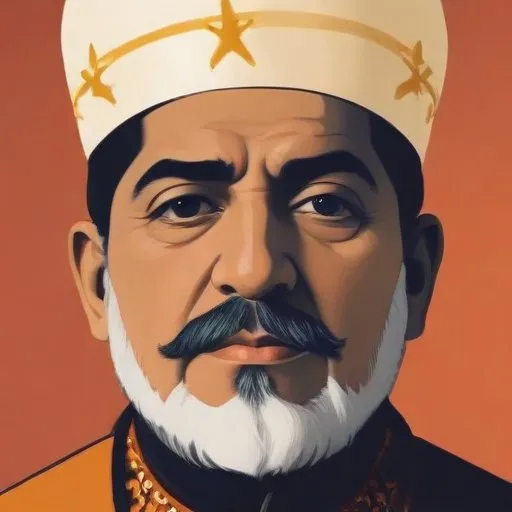
The last ruler of the Qajar dynasty, he's known for his attempts to modernize Persia and his country's tumultuous relationship with European powers during his reign.
Ahmad Shah Qajar, the Shah of Persia (Iran) from 1909 to 1925, is known for being the last ruling member of the Qajar dynasty, a royal house that had dominated Persian politics for over a century. He ascended to the throne at the tender age of 12, following the removal of his father, Mohammad Ali Shah, by the Parliament.
Ahmad Shah was born on January 21, 1898, in Tabriz, Persia. Due to his young age, his uncle, Ali Reza Khan, acted as regent, governing the country on his behalf. Upon reaching the age of majority, Ahmad Shah was formally crowned on July 21, 1914.
During his reign, the Grand Majles, a gathering of 500 delegates from different backgrounds, was convened. This assembly enacted numerous reforms, including the abolition of class representation, the creation of five new seats for minorities, and the democratization of the electoral system. The voting age was also lowered from 25 to 20.
Despite his best efforts, Ahmad Shah's reign was marked by ineffectiveness, internal unrest, and foreign intrusions, particularly by the British Empire and Russian Empire. The country was further destabilized by the presence of Russian and British troops, who fought against the Ottoman Empire forces in Persia during World War I.
The Second Majlis, convened in November 1910, failed to achieve any significant accomplishments, due to the weakness of the central government. This led to a power vacuum, allowing foreign powers to exert their influence over Persia.
Ahmad Shah's personal life remains shrouded in mystery, with little known about his early years before ascending to the throne. After his abdication in 1925, he lived in exile, eventually passing away on February 21, 1930.
Ahmad Shah Qajar's reign marked the end of the Qajar dynasty, paving the way for the rise of the Pahlavi dynasty. His legacy is a complex one, marked by both the democratization of the electoral system and the country's vulnerability to foreign influence.
Ahmad Shah's reign can be compared to that of his contemporaries, such as the Ottoman Empire's Sultan Mehmed VI, who faced similar challenges in the face of foreign intervention and internal unrest.
Ahmad Shah Qajar's story serves as a reminder of the complexities of Persian history, a testament to the country's resilience in the face of adversity.
Born in 1898
The last ruler of the Qajar dynasty, he's known for his attempts to modernize Persia and his country's tumultuous relationship with European powers during his reign.
Born in 1878
Modernized Iran's infrastructure, military, and education system, while suppressing democratic movements and dissent.
Born in 1772
The second ruler of the Qajar dynasty, he's known for his military campaigns, administrative reforms, and cultural achievements, including the development of Persian literature and art. He also established Tehran as the capital of Iran.
Born in 1919
The last monarch of the Pahlavi dynasty, ruling Iran from 1941 until the 1979 revolution, known for his modernization efforts and close ties to the West. His regime was marked by controversy, including a CIA-backed coup and brutal suppression of dissent.
