


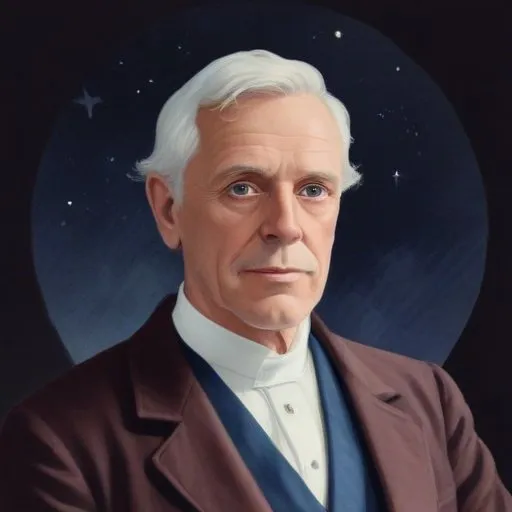
American astronomer who studied nebulae and was a key figure in the "Great Debate" on the scale of the universe, advocating for an "island universe" theory. He also discovered many galaxies and nebulae.
Heber Doust Curtis, a pioneering American astronomer, is renowned for his groundbreaking work on solar eclipses and his advocacy for the existence of galaxies beyond the Milky Way. His involvement in the legendary Shapley-Curtis Debate in 1920 revolutionized our understanding of the universe, propelling Curtis to the forefront of astronomical research.
Born on June 27, 1872, in Michigan, Curtis was the elder son of Orson Blair Curtis and Sarah Eliza Doust. He pursued his academic interests at the University of Michigan and later at the University of Virginia, where he earned a degree in astronomy.
Curtis's astronomical career took off in 1902 when he joined the Lick Observatory in California. He continued the survey of nebulae initiated by Keeler and later headed the Lick southern station in Chile from 1905 to 1909. During this period, he returned to take charge of the Crossley telescope, a 36-inch refracting telescope. In 1912, Curtis was elected president of the Astronomical Society of the Pacific.
In 1918, Curtis made a significant observation of Messier 87, where he noticed a polar jet, which he described as a "curious straight ray... apparently connected with the nucleus by a thin line of matter." This observation marked a crucial milestone in his research.
In 1920, Curtis engaged in the Great Debate with Harlow Shapley, a discussion that would change the course of astronomical history. Curtis advocated for the existence of galaxies beyond the Milky Way, while Shapley argued that the observed nebulae were part of the Milky Way. Although the debate ended without a clear resolution, Curtis's views ultimately prevailed, and his work laid the foundation for modern understanding of the universe.
Curtis's inventive spirit led him to design a unique film plate comparator in 1925. This device allowed for the comparison of two 8x10-inch plates using a set of prisms and stacked stages, rather than placing them side by side. This innovation enabled more efficient and accurate astronomical research.
In 1930, Curtis became the director of the University of Michigan observatory. Throughout his career, he made significant contributions to the field of astronomy, earning him recognition and respect from his peers. His work continues to inspire new generations of astronomers and scholars.
Heber Doust Curtis's pioneering work and innovative spirit have left an indelible mark on the field of astronomy, propelling humanity's understanding of the universe forward.
Born in 1885
Measured the galaxy's size and mapped the Milky Way's structure, revolutionizing our understanding of the universe.
Born in 1877
Developed the Hertzsprung-Russell diagram, a fundamental tool in astronomy that relates stars' brightness to their surface temperature. This diagram is still widely used today to understand the life cycles of stars.
Born in 1873
Developed the Hertzsprung-Russell diagram, a fundamental tool in astronomy that relates stars' brightness to their color and temperature. This diagram revolutionized our understanding of stars and their life cycles.
Born in 1873
Developed the first modern solution to Einstein's general theory of relativity, describing the curvature of spacetime around a massive object, and predicted the existence of black holes.
Born in 1882
A pioneer in astrophysics, he formulated the Eddington limit, a crucial concept in understanding stars, and was a key figure in popularizing Einstein's theory of relativity. His work bridged the gap between theory and observation in astronomy.
Born in 1868
Founded the Mount Wilson Observatory, pioneered the field of astrophysics, and developed innovative telescopes, making groundbreaking discoveries about the sun and stars.
Born in 1863
Pioneering astronomer who classified over 350,000 stars and developed a system of stellar classification still used today. Her work paved the way for future astronomers to better understand the universe.
Born in 1900
Pioneering astronomer who discovered that stars are primarily composed of hydrogen and helium, revolutionizing our understanding of the universe. Her groundbreaking work paved the way for future generations of astronomers.
