


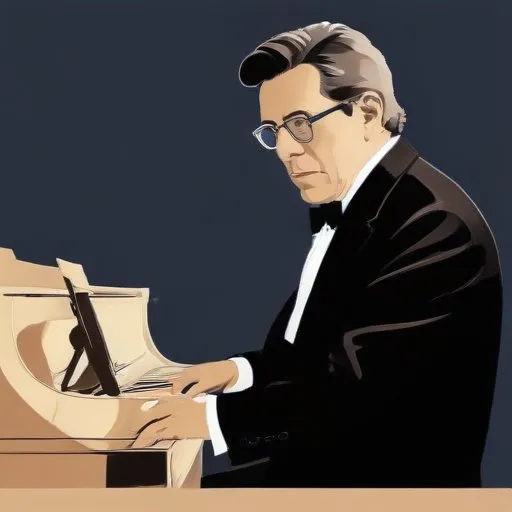
A renowned French pianist, composer, and educator, he was a prominent figure in 20th-century classical music, celebrated for his unique and innovative compositions.
Henri Dutilleux, one of the most renowned French composers of the 20th century, left an indelible mark on the world of classical music with his unique, Impressionistic style that seamlessly blended tradition with innovation. His works, characterized by sensuous harmony and color, are a testament to his singular voice, which defied the influence of his contemporaries, including Olivier Messiaen and Pierre Boulez.
Born on January 22, 1916, in Angers, Maine-et-Loire, France, Dutilleux came from a family with a rich artistic heritage. His great-grandfather, Constant Dutilleux, was a painter, and his grandfather, Julien Koszul, was a composer. This cultural backdrop likely contributed to Dutilleux's early fascination with music, which led him to study harmony, counterpoint, and piano with Victor Gallois at the Douai Conservatoire.
Dutilleux's compositional journey began in the 1940s, with his early works showcasing a distinct Impressionistic style reminiscent of Debussy and Ravel. However, it was his Flute Sonatine and Piano Sonata, composed in the 1940s and 1950s, respectively, that truly established him as a force to be reckoned with in the classical music world.
Dutilleux's contributions to classical music were recognized with numerous awards and honors, including the prestigious Grand Prix de Rome in 1938 and the Ernst von Siemens Music Prize in 2005. These accolades not only cemented his reputation as a master composer but also underscored his influence on modern classical music.
Beyond composing, Dutilleux was an esteemed educator, having taught at the École Normale de Musique de Paris and the Conservatoire National Supérieur de Musique. He also served as the Head of Music Production for Radio France for 18 years, during which time he collaborated with several prominent artists, including Charles Munch, George Szell, and Mstislav Rostropovich.
Henri Dutilleux's legacy extends far beyond his impressive body of work. He inspired a new generation of composers, including Tristan Murail and Gérard Grisey, who drew upon his innovative approach to harmony and timbre. As the music critic Paul Griffiths so eloquently put it, Dutilleux's "position in French music was proudly solitary," a testament to his unwavering commitment to his artistic vision.
Born in 1908
A French composer and ornithologist who merged birdsong with avant-garde music, creating a unique and influential sound. His work continues to inspire musicians and bird enthusiasts alike.
Born in 1875
A renowned French musician who blended classical and modern styles, creating iconic works like "Bolero" that continue to mesmerize audiences with their beauty and complexity.
Born in 1862
A renowned French pianist and composer who revolutionized classical music with his unique, dreamy, and unconventional style, creating iconic works like "Clair de Lune" and "Prelude to the Afternoon of a Faun".
Born in 1925
A renowned French musician who revolutionized classical music with his avant-garde compositions and innovative conducting style, pushing boundaries and redefining the genre.
Born in 1905
A French composer who blended modernist techniques with ancient and exotic influences, creating a unique sound that explored the intersection of Western and non-Western musical traditions.
64 Years Old
Renowned for his lyrical and nuanced performances, this pianist is celebrated for his interpretations of the Romantic repertoire, particularly the works of Liszt and Ravel.
Born in 1924
A renowned French conductor, known for his interpretations of classical music, particularly French repertoire, and his work with prominent orchestras.
Born in 1899
A renowned violinist and conductor, leading the Philadelphia Orchestra for over 40 years, known for his technical precision and interpretations of Romantic-era composers.
