


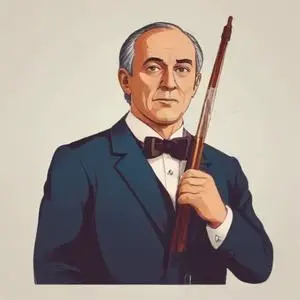
A renowned violinist and conductor, leading the Philadelphia Orchestra for over 40 years, known for his technical precision and interpretations of Romantic-era composers.
Eugene Ormandy, a Hungarian-born American conductor and violinist, is best known for his 44-year association with the Philadelphia Orchestra, serving as its music director from 1936 to 1980. During his tenure, Ormandy transformed the orchestra into one of the world's most renowned ensembles, earning three gold records and two Grammy Awards.
Born as Jen Blau on November 18, 1899, in Budapest, Austria-Hungary, Ormandy was raised in a musical family. His father, a dentist and amateur violinist, taught him violin lessons at the age of three and a half. The young prodigy entered the Royal National Hungarian Academy of Music at five, becoming the youngest student to date. He later studied under Jen Hubay, passing the finals in chamber music and violin in 1915.
From 1917 to 1920, Ormandy toured Hungary and Germany, serving as concertmaster of the Berlin Blthner Orchestra. He briefly taught violin at his alma mater before immigrating to the United States in 1921. In the early 1920s, he worked as a freelance violinist and conductor, gradually building a reputation as a skilled technician and expert orchestral builder.
In 1936, Ormandy was appointed music director of the Philadelphia Orchestra, a position he held for 44 years, making it one of the longest tenures of any conductor with an American orchestra. During his leadership, the orchestra flourished, and Ormandy became known for his precise and expressive conducting style.
Ormandy made numerous recordings with the Philadelphia Orchestra, as well as guest conducting appearances with European orchestras. His discography includes iconic performances of works by Brahms, Rachmaninoff, and Shostakovich, among others.
Ormandy's contributions to classical music earned him several accolades, including three gold records and two Grammy Awards. He received honorary degrees from institutions such as the University of Pennsylvania and Temple University.
Eugene Ormandy's impact on classical music is immeasurable. He championed the works of contemporary composers, premiered numerous pieces, and mentored young conductors. His 44-year association with the Philadelphia Orchestra set a high standard for artistic excellence, shaping the ensemble into one of the world's most respected orchestras.
Beyond his musical achievements, Ormandy was a devoted husband and father. He supported various charitable organizations, including the Philadelphia Orchestra's educational programs and the Curtis Institute of Music.
One of Ormandy's most famous quotes is: "Music is a gift from God, but it takes a lot of hard work to develop it." His memorabilia, including his violin and conducting scores, are preserved at the Philadelphia Orchestra's archives.
Eugene Ormandy's remarkable career spanned the 20th century, coinciding with significant cultural and historical events. His legacy continues to inspire new generations of musicians, conductors, and music lovers, ensuring the continued relevance of classical music in modern society.
Born in 1867
A renowned conductor who led the NBC Symphony Orchestra and was known for his intense performances and perfectionism, shaping the sound of classical music in the 20th century.
Born in 1882
A renowned conductor who revolutionized the art of orchestral performance with his innovative techniques and charismatic stage presence, leading iconic ensembles like the Philadelphia Orchestra.
Born in 1888
A renowned maestro who led the Chicago Symphony Orchestra to new heights, earning a reputation for his precise and powerful interpretations of classical music.
Born in 1897
A renowned conductor and composer, known for his precise and expressive performances, leading the Cleveland Orchestra to international acclaim. His interpretations of classical music remain highly influential.
Born in 1875
A renowned viola player and conductor, he was a leading figure in the development of modern orchestral performance, particularly in the interpretation of French and Russian music.
Born in 1901
A virtuosic violinist renowned for his technical perfection, tone, and phrasing, revolutionizing the art of violin playing through his recordings and teaching.
Born in 1916
A renowned violinist and conductor who mesmerized audiences with his virtuosic performances and collaborations with esteemed musicians, also a passionate advocate for music education.
81 Years Old
A world-renowned virtuoso, celebrated for mesmerizing performances and iconic recordings that have elevated the art of classical music.
