


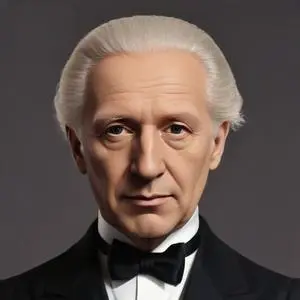
A renowned conductor who revolutionized the art of orchestral performance with his innovative techniques and charismatic stage presence, leading iconic ensembles like the Philadelphia Orchestra.
Leopold Stokowski, one of the most influential conductors of the 20th century, is best known for his unconventional freehand conducting style that rejected the traditional baton, and his ability to extract a rich, sumptuous sound from the orchestras he directed.
Throughout his 60-year career, Stokowski conducted some of the world's most renowned orchestras, including the Philadelphia Orchestra, New York Philharmonic Orchestra, and NBC Symphony Orchestra, leaving an indelible mark on the world of classical music.
Leopold Anthony Stokowski was born on April 18, 1882, in London, England, to an English-born cabinetmaker of Polish heritage and an Irish-born mother.
Showing an early affinity for music, Stokowski began his musical education at the age of seven, studying piano, organ, and singing. He later attended the Royal College of Music, where he honed his skills as a conductor.
Stokowski made his official conducting debut in 1909 with the Cincinnati Symphony Orchestra, beginning a long and distinguished career that would take him to the helm of some of the world's most esteemed orchestras.
He became particularly known for his innovative approach to conducting, eschewing the traditional baton in favor of a more expressive, freehand style that allowed him to convey his passion and energy to the orchestra.
In the 1940s, Stokowski's career took an unexpected turn when he began working in Hollywood, conducting music for several films, including Disney's iconic Fantasia (1940).
This iconic film, which featured Stokowski conducting the Philadelphia Orchestra, introduced classical music to a wider audience and cemented Stokowski's status as a cultural icon.
Throughout his career, Stokowski was a passionate advocate for contemporary composers, premiering works by notable figures such as Stravinsky, Shostakovich, and Rachmaninoff.
This commitment to new music helped to shape the course of classical music, introducing audiences to fresh voices and perspectives.
Leopold Stokowski's influence on classical music extends far beyond his own conducting career. He founded several orchestras, including the All-American Youth Orchestra and the American Symphony Orchestra, and inspired generations of conductors and musicians.
Today, Stokowski's legacy continues to be felt in the world of classical music, where his innovative approach to conducting and his commitment to new music remain an inspiration to musicians and audiences alike.
"The music of the stones, the music of the flowers, the music of the birds, the music of the brook, the music of the sea – all these are the echoes of the divine harmony."
"The conductor must always be aware of the music that is being created, and not just the music that he is trying to create."
These quotes capture Stokowski's deep love and respect for music, as well as his innovative approach to conducting, which continues to inspire musicians and audiences today.
Born in 1901
Creator of beloved animated films and iconic characters, revolutionizing the entertainment industry with imagination and innovation.
Born in 1882
A Russian master of music, renowned for revolutionizing classical music with bold, avant-garde compositions that blended traditional and modern elements. His iconic works, such as "The Rite of Spring," continue to inspire and influence artists across genres.
Born in 1873
A renowned Russian musician who composed iconic symphonies and piano concertos, and was also a skilled pianist and conductor, leaving a lasting legacy in classical music.
Born in 1867
A renowned conductor who led the NBC Symphony Orchestra and was known for his intense performances and perfectionism, shaping the sound of classical music in the 20th century.
Born in 1899
A renowned violinist and conductor, leading the Philadelphia Orchestra for over 40 years, known for his technical precision and interpretations of Romantic-era composers.
Born in 1875
A renowned French musician who blended classical and modern styles, creating iconic works like "Bolero" that continue to mesmerize audiences with their beauty and complexity.
Born in 1898
A renowned pianist and composer who blended jazz and classical music to create iconic works like "Rhapsody in Blue" and "An American in Paris", leaving a lasting impact on American music.
Born in 1918
A renowned musician who blended jazz, classical, and Broadway styles, creating iconic works like West Side Story, and inspiring generations with his charismatic performances and innovative compositions.
